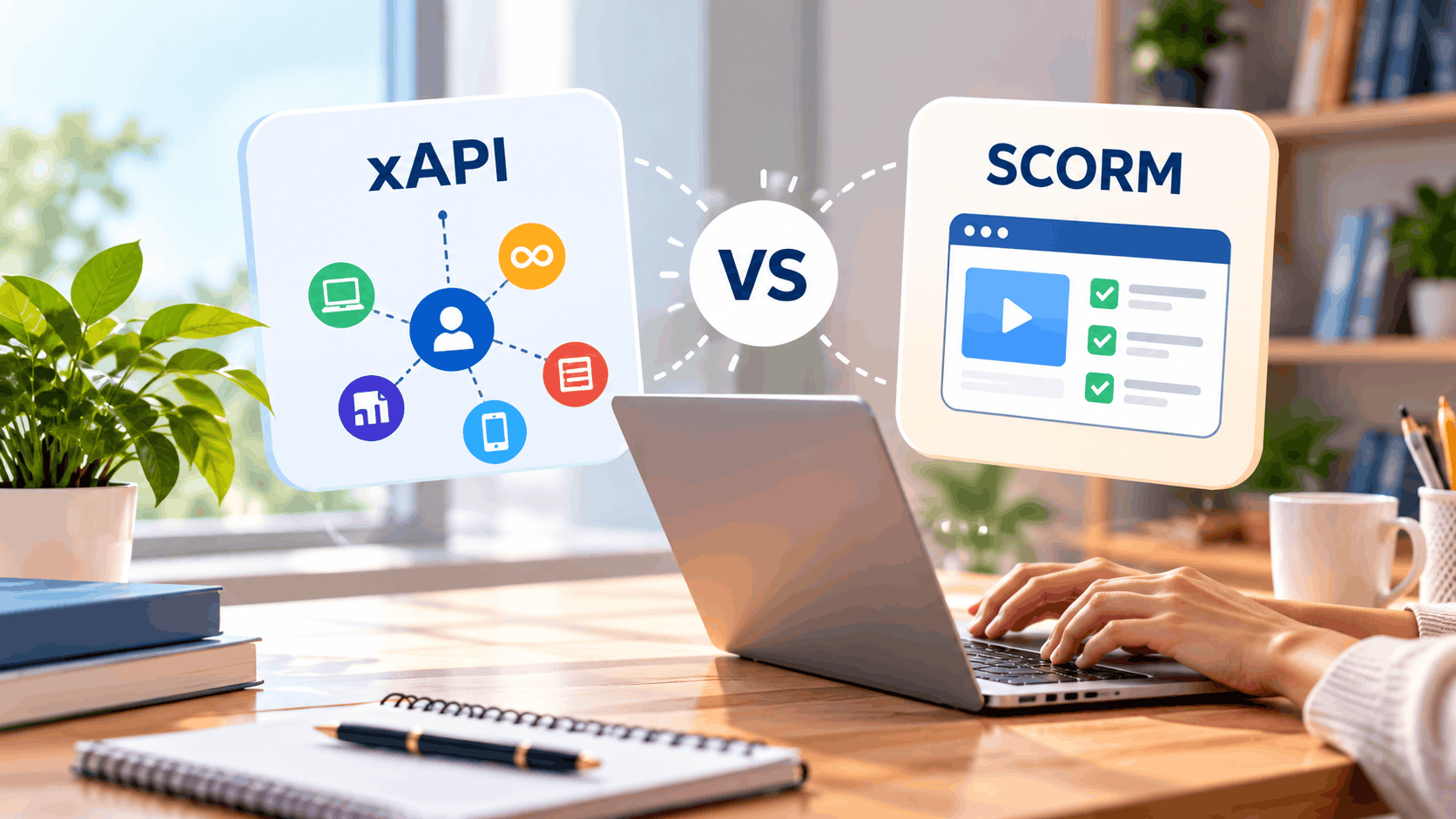
When you publish a course, the file format decides what you can learn about your learners afterwards. Two standards dominate: SCORM, which has been the default for LMS delivered courses for two decades, and xAPI, which tracks learning wherever it happens. Choosing between them affects your reporting, your tools and your budget.
This guide explains both standards, compares them and helps you decide which one suits your training.
What Is SCORM?
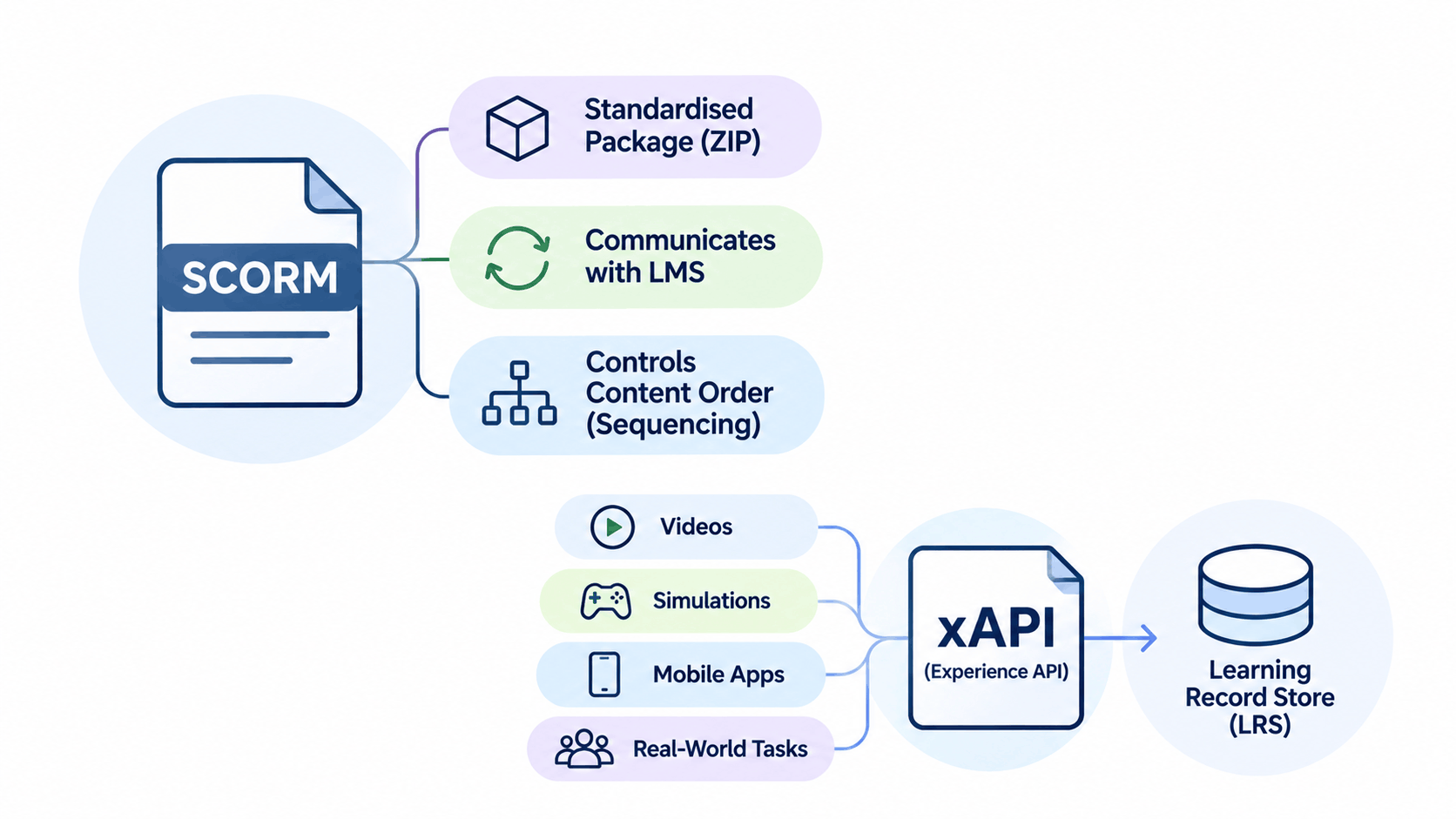
SCORM stands for Sharable Content Object Reference Model. The Advanced Distributed Learning (ADL) initiative describes it as a set of linked technical specifications for browser based eLearning. Its purpose is simple: a course built to the standard should play and report results in any LMS that supports it.
Two versions are in common use. SCORM 1.2, released in 2001, was the first widely adopted version. SCORM 2004 followed with added rules for sequencing content, and its latest release is the 4th Edition from 2009.
How Does SCORM Work?
SCORM standardises three things.
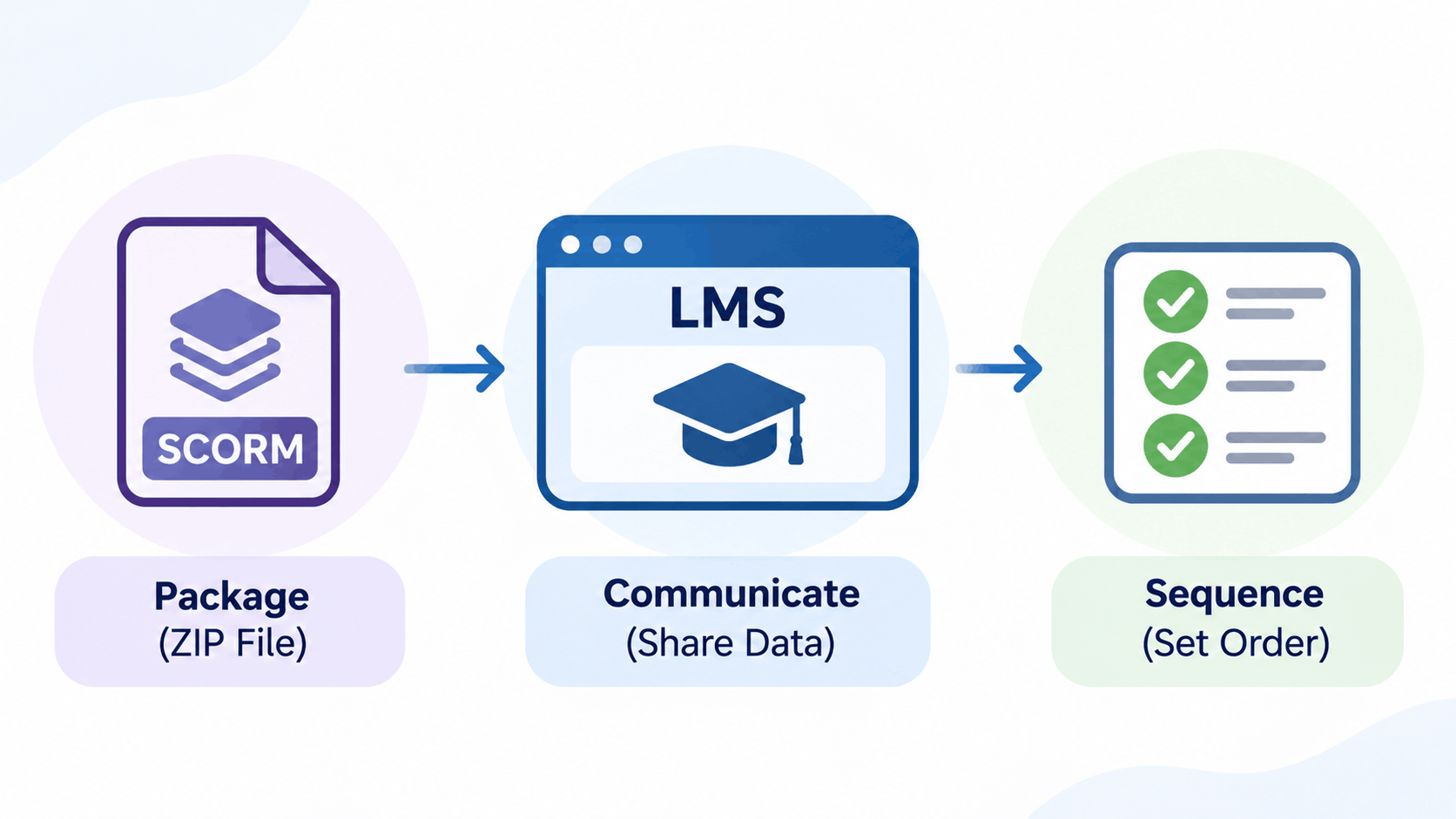
- Packaging. Your course is bundled into a single ZIP file with a manifest that tells the LMS what the course contains. You upload the file once and the LMS reads it.
- Communication. When a learner opens the course from the LMS, the content and the LMS exchange data through a shared set of commands. The course reports progress, completion, scores and time spent, and the LMS records them.
- Sequencing. SCORM 2004 lets you set rules for the order of lessons, such as unlocking a module only after a learner passes the previous one.
The important point is that the LMS sits at the centre. The learner must launch the course from the LMS, and the results stay in that LMS.
What Are the Benefits of SCORM?
- Wide support. Almost every LMS can import SCORM packages, so your content moves between platforms without being rebuilt.
- Reliable core reporting. Completion, pass or fail status, scores and time spent are reported in a consistent way.
- Simple to set up. You need an LMS and a package. No further system is required.
- Mature tools. Authoring tools and vendors have supported SCORM for years, which makes it easy to find skills and help.
When Should You Use SCORM?
Choose SCORM when your training is delivered through an LMS and your reporting needs are straightforward. Typical cases include compliance and policy courses, employee onboarding, product knowledge modules and exam preparation courses where you need completion and score reports. It also suits organisations whose LMS does not support xAPI.
What Is xAPI?
xAPI, also called the Experience API, is, in the words of ADL, a data and interface standard that lets software capture and share data on human performance, along with the context around it. It was formally released as version 1.0 in 2013 and has since been moved toward formal standardisation by the IEEE.
Where SCORM records what happens inside a course launched from an LMS, xAPI can record learning from many sources. ADL lists examples such as video events, simulation progress, mobile app activity, quiz answers for each question and real world operational performance.
How Do xAPI Statements Work?
xAPI records learning as short statements. Each statement has three core parts: an actor, a verb and an object. For example, "Anita completed Safety Induction" or "Ravi watched Machine Setup Video". A statement can also carry a timestamp, a score and context, such as the device or the course it belongs to.
Applications send these statements to a Learning Record Store, or LRS. The LRS receives, validates and stores them, and it can sit inside an LMS or run as a separate system. Because the store is not tied to one course, you can combine statements from different tools and learners and report on them together.
What Are the Benefits of xAPI?
- Detailed data. You see individual actions, such as which answer a learner chose or where a video was paused, instead of only a final score.
- Tracking beyond the LMS. Simulations, mobile apps, videos, workshops and workplace tasks can all report to the same store.
- Better insight into performance. You can connect learning activity with results on the job, which helps you judge whether training works.
- Flexible delivery. Content does not need to run inside an LMS window, so you can use interactive formats. Margo Learning's interactive video modules, for example, are SCORM and xAPI compliant and report completion and score data.
What Is the Difference Between SCORM and xAPI?
| Factor | SCORM | xAPI |
|---|---|---|
| First released | 2001 (version 1.2) | 2013 (version 1.0) |
| What it tracks | Completion, status, scores and time | Any recorded activity, including videos, simulations and real world tasks |
| Where content runs | Inside an LMS | In an LMS, an app or elsewhere |
| Where data is stored | The LMS | A Learning Record Store |
| Level of detail | Course level | Action level |
| Setup | Simple, widely supported | Needs an LRS and planned statements |
| Best suited to | Standard online courses | Simulations, blended learning and performance analysis |
How Do You Choose Between xAPI and SCORM?
Start with the questions you need your data to answer.
Choose SCORM if you need to show who finished a course and what they scored, and your LMS handles the rest. It is the quicker and cheaper route for a standard course.
Choose xAPI if you need to see what learners do inside interactive content, track activity outside the LMS or link learning with performance. Interactive simulations, such as the 3D animation scenarios Margo Learning builds, show where xAPI helps most, because it can record what a learner does at each step.
Check three practical points before you decide. First, confirm which standards your LMS supports. Second, ask whether you have or can add an LRS. Third, decide who will read the data and what they will do with it. Collecting detail nobody uses adds cost without benefit.
You do not always have to choose. Many organisations use SCORM for standard courses and xAPI for selected programmes. ADL, which maintains SCORM, recommends xAPI and cmi5 for new implementations, and cmi5 adds LMS launch rules to xAPI.
How Can Margo Learning Help You?
Margo Learning packages every course as SCORM 1.2, SCORM 2004 or xAPI and tests it on your LMS before delivery. Its courseware development team also provides source files and production documents for later updates. Contact Margo Learning to discuss your platform and agree the right format.
Frequently Asked Questions
Not entirely. SCORM remains widely used and well supported, while xAPI is growing where richer data is needed. Many teams use both.