
Most people do not struggle to learn. They struggle to find an hour for it. A sales team between client calls, a nurse on a short break and a student on a bus all have a few spare minutes and very little spare attention. Microlearning is built for exactly that situation, and it has become one of the most practical ways to deliver training that people actually finish.
This guide explains what microlearning is, how it works, what it can do for your learners, where it falls short and which formats you can start with.
What Is Microlearning?
Microlearning is a way of teaching through small, focused units that each cover a single idea or skill. A unit may be a two minute video, a short quiz, a one page checklist or a few audio minutes. A scoping review of 17 studies in health professions education, published in JMIR Medical Education, describes these units as typically under 15 minutes and centred on one self contained idea. The same review notes that there is no universal definition, so what counts as micro depends on the topic and the learner.
The key feature is focus. A microlearning unit has one objective, and a learner should be able to state what they gained when it ends.
How Does Microlearning Work?
Microlearning works by splitting a larger subject into a sequence of short lessons, then delivering them in a pattern that helps memory.
First, you identify the objective and divide it into separate ideas. A course on customer service, for example, might become units on greeting a customer, handling a complaint and closing a call. Margo Learning's instructional design solutions can help you set clear objectives and sequence them before any content is made.
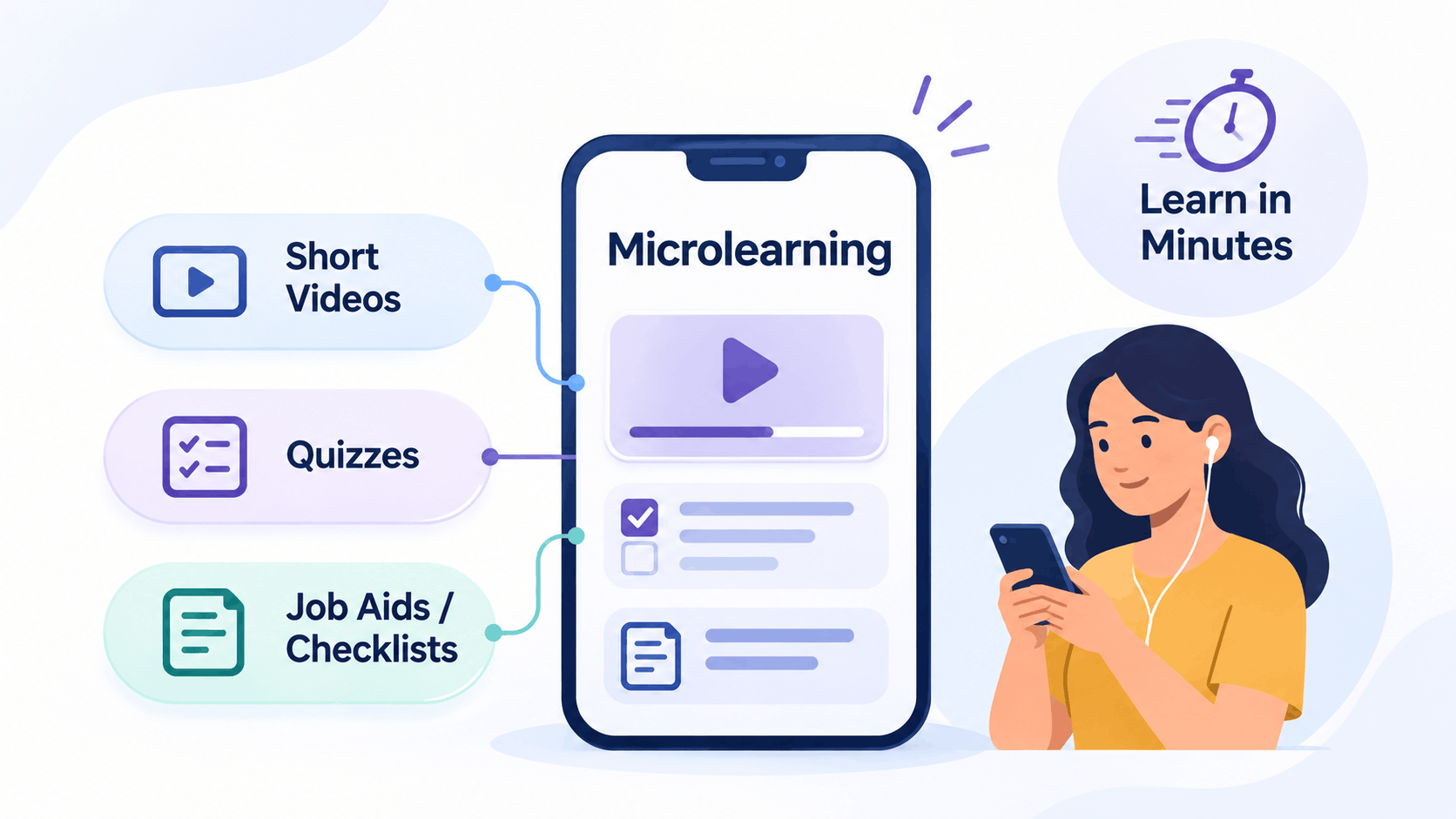
Second, each idea receives its own short asset, built for its format. A process is best shown in an explainer video, a fact is best tested with a quiz and a procedure is best captured in a job aid.
Third, you spread the units over days or weeks instead of presenting them at once. Research on spaced learning supports this approach, because studying material in separate sessions improves performance on later tests compared with studying it in one block. Recalling earlier material between units strengthens the effect, since remembering information makes it easier to retrieve again.
Finally, short prompts or quizzes remind learners to return after the first unit.
What Are the Benefits of Microlearning?
- It fits into a working day. Short units can be completed between tasks, on a phone or at a desk, so learners do not need to block out hours of study.
- It supports retention. Because units are spaced and often end with a question, learners practise recalling what they learned. The JMIR review found positive effects on knowledge, confidence in performing procedures and retaining information.
- It keeps attention on one idea. A short unit leaves less room for distraction, and learners know exactly what they are meant to take away.
- It is easier to update. When a policy, product or procedure changes, you revise one unit and leave the rest of the course untouched.
- It suits many audiences. The same approach works for employee onboarding, compliance refreshers, exam revision and school lessons. Each unit has a single objective, so quiz results also show you which ideas need another look.
What Are the Challenges of Microlearning?
Microlearning is not the answer to every training need, and you should plan for its limits.
- Depth. A few minutes cannot carry a complex subject on their own. Topics that need long reasoning, discussion or hands on practice should use microlearning as support for a fuller course.
- Fragmentation. Disconnected units can leave learners without a view of how the pieces fit together. A clear learning path solves this.
- Passive viewing. The JMIR review warns that watching recorded content can replace active learning. Add a question, a task or a choice to each unit.
- Production effort. Writing many small assets with a clear objective each takes planning. The review notes that building content can be time consuming.
- Access. Learners need suitable devices and connections, and the review points out that access is not equal for everyone.
- Measurement. The same review found that most studies measured reactions and learning, while very few measured changes in behaviour and none measured results in practice. You should decide early how you will measure on the job impact.
What Are Some Examples of Microlearning?
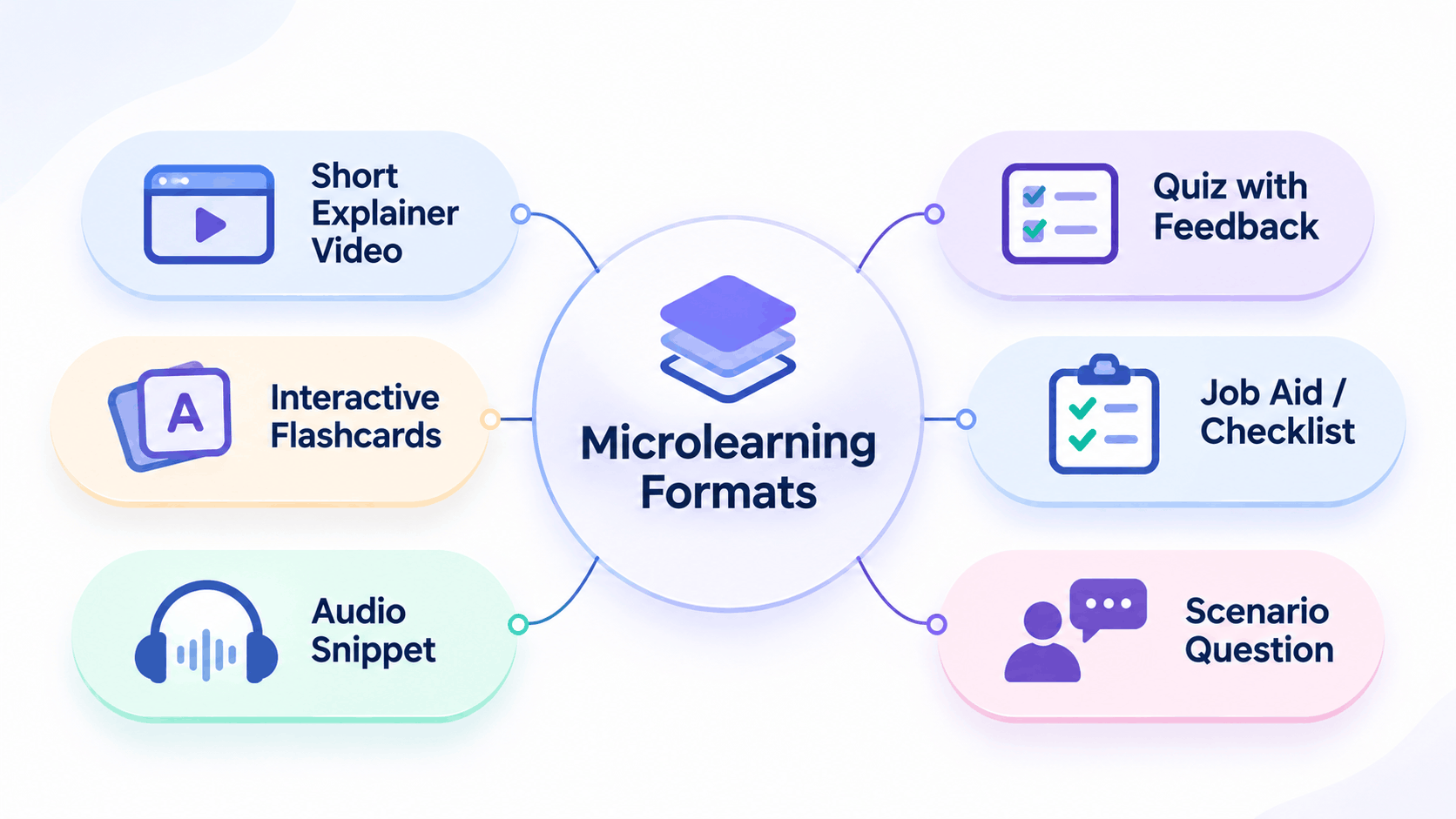
The right format depends on what your learners need to do. The table below shows common choices.
| Format | Typical length | Best used for |
|---|---|---|
| Short explainer video | 1 to 3 minutes | Introducing a concept or a process |
| Interactive flashcards | 1 to 2 minutes | Learning terms, facts and definitions |
| Quiz with feedback | 2 to 5 minutes | Checking understanding and strengthening recall |
| Audio snippet | 3 to 5 minutes | Learning while commuting or travelling |
| Job aid or checklist | One page | Supporting a task at the point of work |
| Scenario question | 2 to 4 minutes | Practising decisions in a realistic situation |
A few uses show how these fit together. A retail company can send a three minute video on a new product every week, followed by a quiz. A hospital can give nurses a one page checklist and a short scenario on a new procedure. A compliance team can replace an annual two hour session with short monthly refreshers.
Whatever format you choose, keep each unit to one objective, end with a question or a task and place the units in a sensible order.
How Can Margo Learning Help You Create Microlearning?
Good microlearning takes careful planning, because every unit has to be short without losing accuracy. Margo Learning's microlearning modules include short animated videos, flashcards, quizzes, audio snippets and job aids, with each asset built for its format and aimed at a single concept. Video units are produced from script to delivery, with subject expert review, voiceover in more than 30 languages and captioning. Files are available in formats that work with your learning management system. Contact Margo Learning to discuss your training goals and agree the right set of units.
Frequently Asked Questions
Most units run from one to five minutes, and the JMIR review describes them as typically under 15 minutes. Let the objective decide, and keep each unit to a single idea.