

Plenty of courses have accurate content, a capable trainer and a good platform, and still change nothing about how people work. The usual cause is the design. Instructional design is the practice of planning every activity in a course around the result the learner must reach.
This article covers what instructional design is, who does the work, how a project runs, which models apply and where the work shows up in practice.
What Is Instructional Design?
Instructional design is a structured way of working out what people need to learn, then designing, building, delivering and evaluating the course that teaches it. It borrows from learning science, cognitive psychology and performance improvement. The field is also called instructional systems design (ISD), and its methods grew out of military and government training in the 1950s and 1960s.
Clarity is the core principle. Learners should know in advance what a course will give them and how they will be assessed. Each lesson, activity and test then points back to that purpose.
Instructional design differs from curriculum development in scope. Instructional design shapes a single course or learning experience. Curriculum development plans the sequence of learning across a whole programme.
What Is an Instructional Designer?
An instructional designer plans and builds learning experiences. The role links subject matter experts, who know the content, with learners, who have to use it. The designer decides what to teach, in what order, in which format and how to measure the result.
A designer's day to day work covers five tasks:
- Analysing the performance gap and deciding whether training is the right solution
- Writing measurable learning objectives
- Designing the structure, activities and delivery format
- Developing content and assessments with subject experts
- Implementing the course and evaluating its results
Related job titles include learning experience designer, eLearning developer and performance consultant. The core skills are needs analysis, objective writing, knowledge of adult learning, command of authoring tools and the ability to work with stakeholders.
What Is the Instructional Design Process?
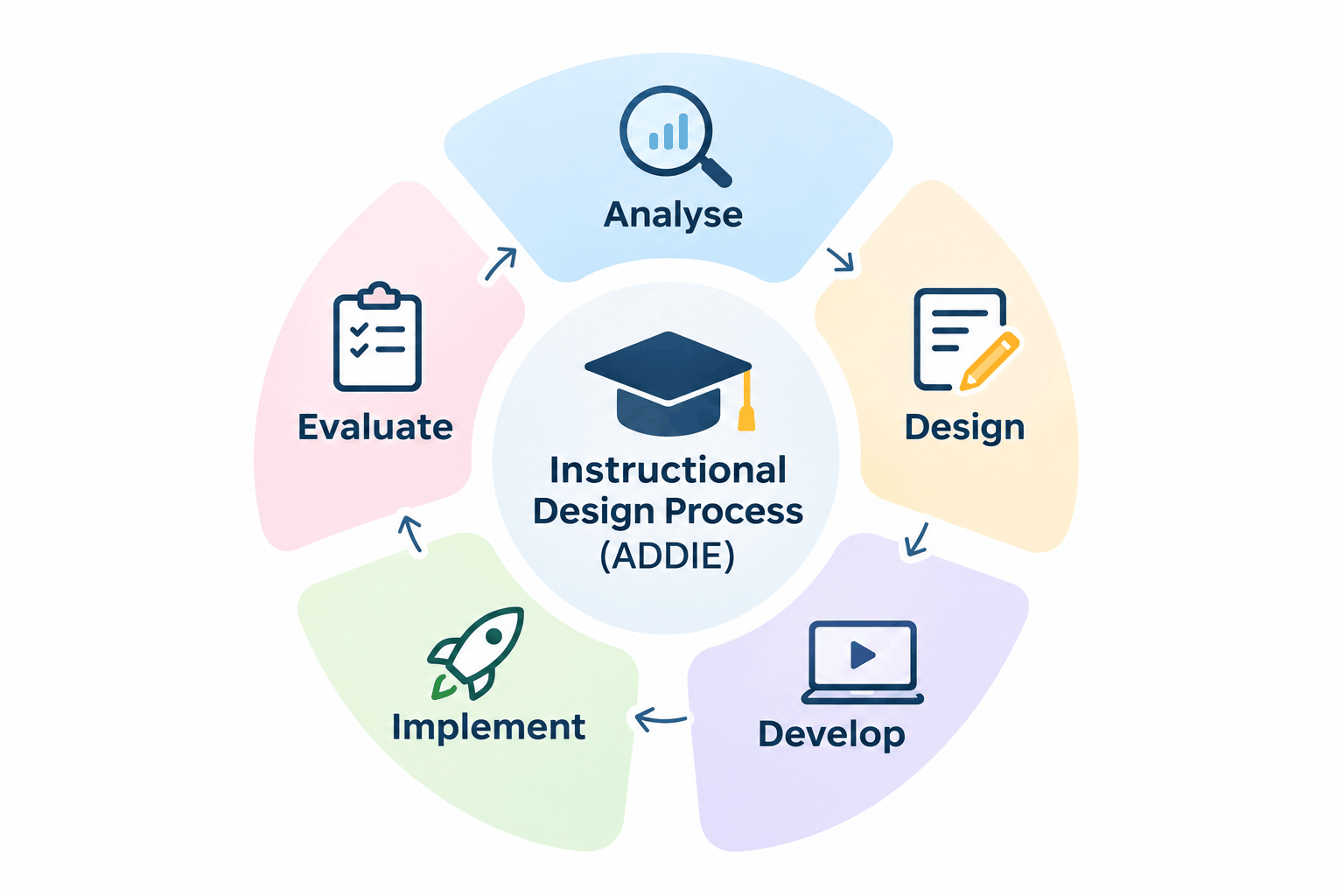
Most projects move through five stages.
- Analyse. Identify the audience, the skill or performance gap, the business goal and the practical limits on time, budget and technology.
- Design. Write the learning objectives, outline the modules, choose the format and plan how each objective will be assessed.
- Develop. Write scripts, build storyboards and produce the course materials, with subject experts reviewing for accuracy.
- Implement. Upload the course to a learning management system, run a pilot with a small group and then release it to the full audience.
- Evaluate. Measure reactions, learning, behaviour on the job and business results, then revise the course.
These stages follow the ADDIE model. Many designers also plan in reverse order. This approach, called backward design, defines outcomes first, plans how learners will demonstrate them and only then creates content and activities. The sequence prevents material that serves no objective.
Which Instructional Design Models Can You Use?
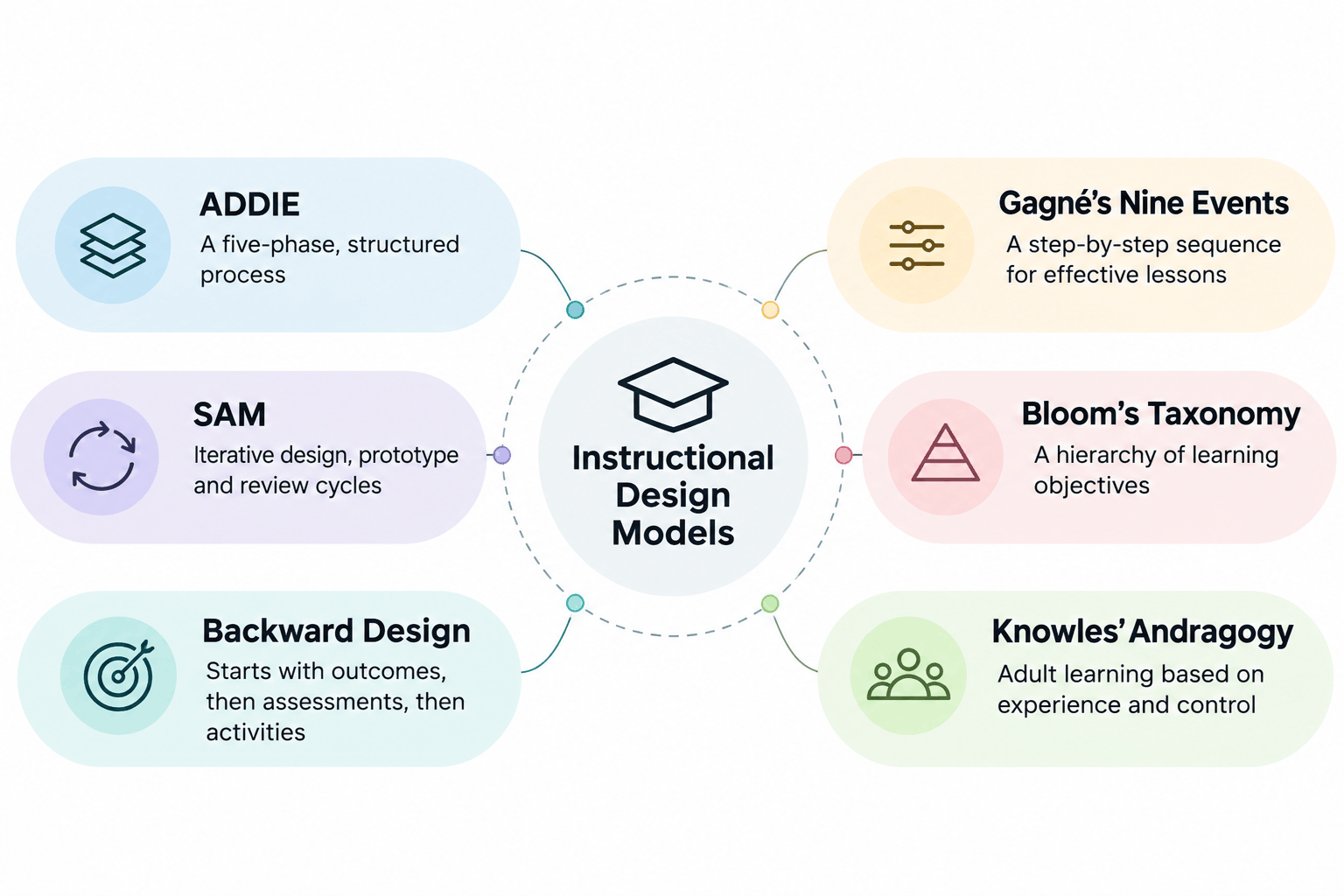
A model gives the process a structure. The table lists the models in most common use.
| Model | What it does | Best suited to |
|---|---|---|
| ADDIE | Follows five phases: analysis, design, development, implementation and evaluation | Projects with clear requirements and a fixed scope |
| SAM (Successive Approximation Model) | Builds the course in repeated rounds of design, prototype and review | Projects that need fast progress and frequent stakeholder input |
| Backward design | Starts with outcomes, then assessments, then activities | Courses where results must be measurable |
| Gagné's Nine Events of Instruction | Gives a fixed sequence for a lesson, from gaining attention to supporting retention and transfer | Planning individual lessons |
| Bloom's Taxonomy | Classifies objectives from remembering to creating | Writing objectives at the right level |
| Knowles' andragogy | Applies the principle that adults bring experience and want control over their learning | Adult and workplace learning |
The models work together. ADDIE or SAM organises the project, Bloom's Taxonomy shapes the objectives, and Gagné's events structure each lesson. ADDIE is linear and systematic, while SAM favours iteration and collaboration, which speeds progress but adds review cycles.
What Are Some Examples of Instructional Design?
Compliance training. A needs analysis shows that employees fail policy quizzes. The designer builds scenario based eLearning with branching decisions and a final assessment on the same topics.
Product onboarding. A company combines an online module on product features with an in person evaluation where new staff demonstrate what they learned.
Software rollout. The designer creates short video walkthroughs and one page job aids, so employees can find help at the moment of need.
The outputs of this work include eLearning courses, storyboards, video scripts, job aids, assessments, facilitator guides, learning paths and evaluation plans. Margo Learning's courseware development services produce many of these deliverables, from foundational materials to interactive and immersive content.
What Are the Benefits of Instructional Design?
Training that solves real problems. Design starts from a performance gap, so less money goes to courses that change nothing.
Better performance. Clear objectives and practice tasks help learners apply new skills at work.
Consistency at scale. A designed course delivers the same quality to every team and region.
Alignment with business goals. Each course links to a result the organisation wants.
How Can Margo Learning Help You With Instructional Design?
Margo Learning's instructional design solutions turn subject matter and legacy training into structured digital learning. The service covers training needs analysis, design blueprints, eLearning architecture for tools such as Articulate Storyline and Adobe Captivate, facilitator guides, and evaluation frameworks based on the Kirkpatrick model. Contact Margo Learning to discuss your training goals and agree the next step.
Frequently Asked Questions
Instructional design is the planned creation of learning experiences. A designer analyses what learners need, sets clear objectives, builds the content and activities, and measures whether the training worked. The aim is a change in what people know or can do.