

Most learners will spend an hour trying to finish a difficult level of a game, yet many lose interest in a ten-minute lesson. Nobody needs to explain the rules of a game twice. The goals are clear, progress is visible and every action gets an immediate response. Gamification in education takes those same qualities and applies them to learning.
This article explains what gamification in education is, how it works, where it is used, its benefits and limits, and the tools that make it practical.
What Is Gamification in Education?
Gamification in education is the use of game elements, such as points, levels, challenges and rewards, in a learning activity that is not itself a game. The lesson stays the same. What changes is the way learners move through it, receive feedback and see their progress.
It is often confused with game-based learning, but the two are different. Game-based learning uses an actual game to teach, such as a simulation or a maths puzzle game. Gamification keeps the existing course and adds a layer of game mechanics on top. A history quiz that awards points and unlocks the next chapter is gamified. A historical strategy game played in class is game-based learning.
Gamification in learning applies equally to schools, universities and workplaces. A child earning stars for completed reading, a student climbing a quiz leaderboard and an employee earning a badge for finishing compliance training are all examples of the same idea.
How Does Gamification in Learning Work?
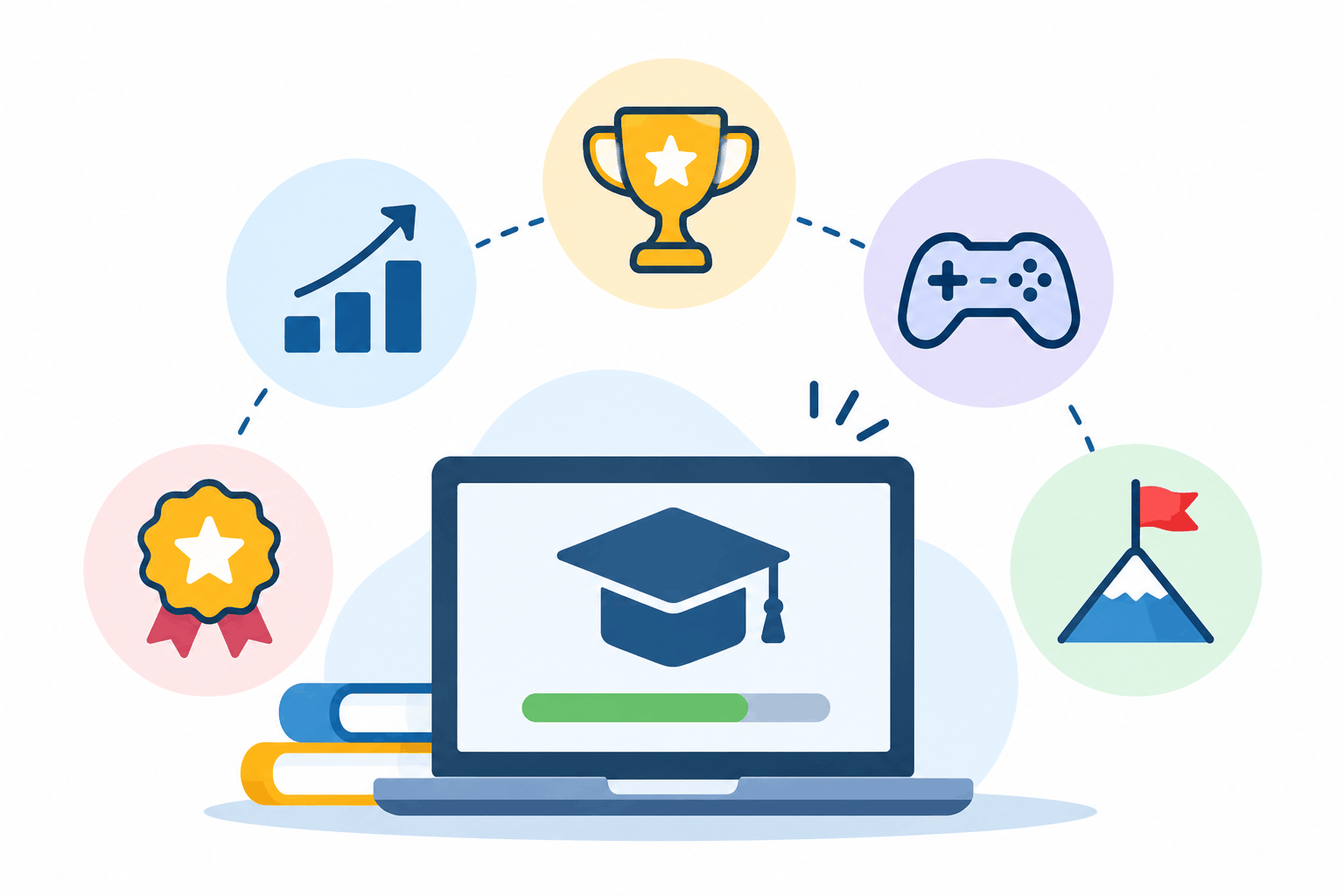
Gamification works because it gives learners three things that ordinary coursework often lacks: a clear goal, visible progress and fast feedback. The most common elements are:
- Points. Learners earn points for completing tasks, answering correctly or helping others.
- Levels and progress bars. Content is divided into stages, so learners can see how far they have come and what remains.
- Badges and certificates. Digital rewards recognise specific achievements, such as finishing a module or mastering a skill.
- Leaderboards. Rankings show how learners or teams compare, which adds friendly competition.
- Challenges and quests. Tasks are framed as missions with a goal, a time limit or a story.
- Instant feedback. Learners know straight away whether an answer is right and why.
- Unlocking. New content opens only when the previous step is complete, which encourages mastery before moving on.
The most effective courses use only the elements that serve the learning goal. Adding every mechanic at once tends to distract rather than motivate.
Examples of Gamification in Education
- Primary school reading. A teacher sets up a reading challenge in which each completed book earns points. The class works towards a shared target, and pupils who reach individual milestones receive a badge on the class board.
- Secondary school revision. Before an examination, a teacher runs a live quiz in which students answer on their phones. Points are awarded for speed and accuracy, and the teacher uses the results to see which topics need another lesson.
- University courses. A lecturer divides a semester into levels. Students unlock each new unit by passing a short assessment, and optional side quests earn extra credit for deeper reading.
- Language learning. Language apps are among the best-known examples. Daily streaks, short levels and instant correction encourage learners to practise a little every day rather than cramming.
- Corporate training. A company turns its onboarding programme into a series of missions. New employees earn badges for each completed module, and teams compete on a leaderboard during product training.
What Are the Benefits of Gamification in Education?
Ask any teacher who has run a points-based quiz before an examination, and they will describe the same thing. Students who usually sit quietly start putting their hands up. That change in the room is the most visible benefit, but it is not the only one.
Learners start, and they finish. A progress bar tells people how much of a course is left. It sounds minor. In self-paced training, though, learners often drift away once they lose sight of the end, and a simple marker of how far they have come keeps many of them going.
Mistakes stop feeling costly. In a game, losing a round is part of playing. Learners bring that attitude to a gamified quiz, so they attempt the difficult question instead of skipping it. They also find out at once where they went wrong. Compare that with a written assignment returned a week later, when the student has already moved on to the next topic.
Practice becomes a habit. Short daily challenges give learners a reason to come back tomorrow. Each return is one more round of recall, and it is this repetition, more than any single lesson, that helps knowledge stay.
Teachers see where learners struggle. Every point earned leaves a record. If half the class keeps failing the same level, the teacher knows which lesson to revisit on Monday, without waiting for the end-of-term test.
What Are the Limitations of Gamification?
Gamification is not a cure for weak content, and it can backfire when it is poorly designed:
- Rewards can replace interest. If learners work only for points, motivation may fade when the rewards stop.
- Leaderboards can discourage. Learners who stay near the bottom may disengage. Team rankings or personal-best tracking avoid this.
- Surface learning. Fast-paced quizzes reward quick recall but may not test deeper understanding.
- Design time. A well-gamified course takes careful planning, especially for scoring and progression.
The answer is to treat game elements as support for learning objectives, never as a substitute for them.
What Tools Are Used for Gamification in Education?
There is no single gamification tool, and most schools and companies end up using a mix. The right choice depends less on the list of features than on where the learning takes place.
For a teacher who wants a lively revision lesson, a live quiz platform is usually the easiest place to begin. Students answer on their phones, points appear on the board, and the whole class sees the results within seconds. These tools work well for quick checks before an examination. They are less suited to teaching new material.
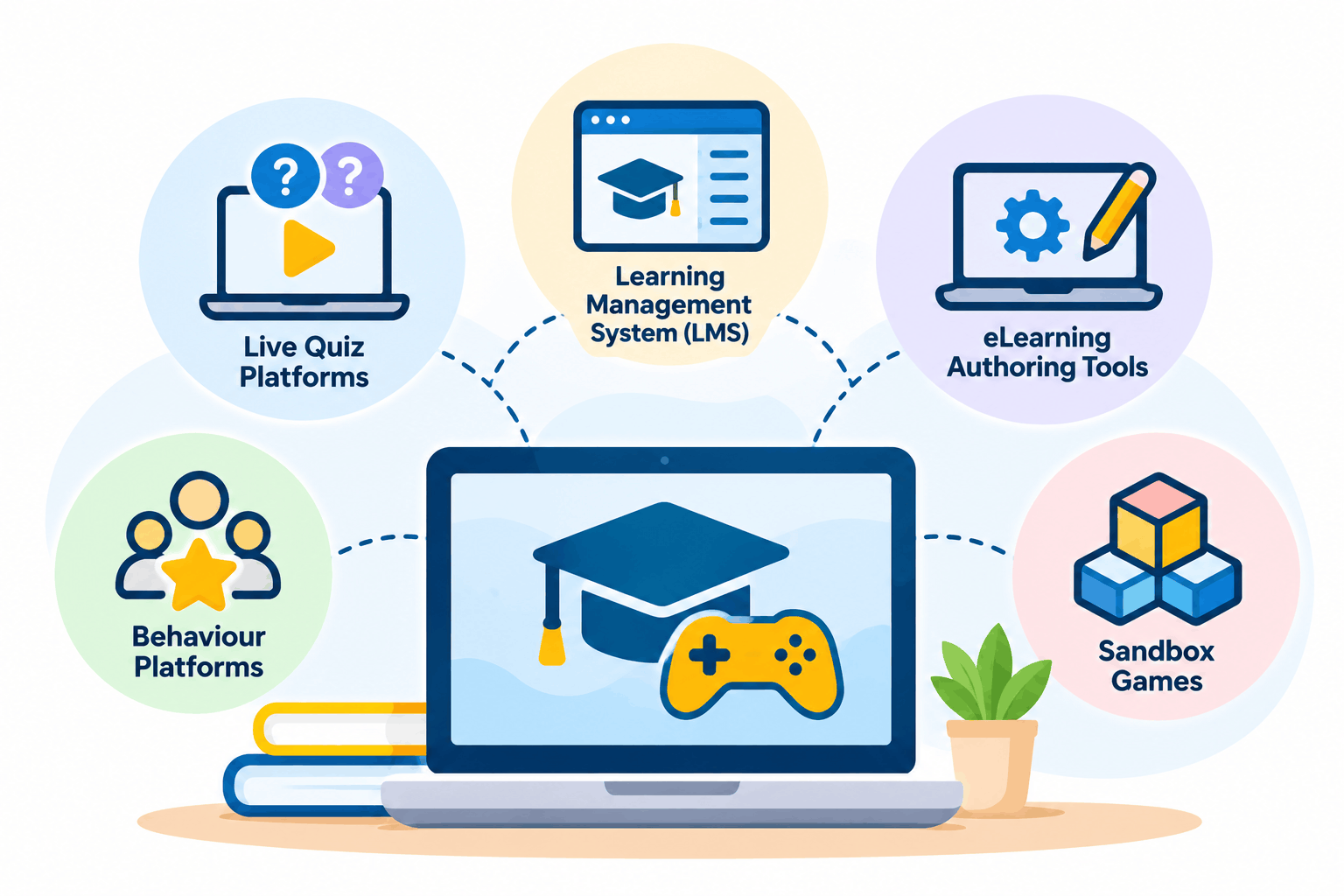
An organisation that already runs a learning management system may not need to buy anything at all. Many platforms can award badges, track levels and issue a certificate once a learner passes. It is worth asking your administrator what the current system can do before paying for a separate product.
When the aim is a complete self-paced course, eLearning authoring tools offer far more control. Designers can build branching scenarios, where each decision leads to a different outcome, and lock later lessons until the earlier ones are finished. Corporate training teams often take this route, because the finished module can be uploaded to any LMS that supports SCORM or xAPI.
Younger classrooms tend to use behaviour platforms, where pupils earn points for participation, teamwork or good conduct, sometimes through a character they design themselves. Sandbox games sit at the other end. Learners build and explore inside a game world, and teachers use them for project work in subjects such as science, history and design.
How Do You Gamify a Course Effectively?
- Start with the learning objective. Decide what learners must know or do, then choose the mechanics that support it.
- Reward progress, not only speed. Points for effort, improvement and accuracy keep slower learners involved.
- Break content into levels. Short stages make progress visible and keep each step manageable.
- Build meaningful assessments. Questions should test understanding, not only memory. Well-written assessment creation gives every point and badge real value.
- Mix competition with collaboration. Combine individual goals with team challenges.
- Measure and refine. Use completion and score data to adjust difficulty and rewards.
How Can Margo Learning Help You Gamify Learning?
Game elements only work when they sit on top of strong content. Margo Learning's courseware development services produce interactive eLearning with scoring, branching scenarios, levels and badges, built in SCORM or xAPI format and tested on your LMS. Our instructional designers and subject experts make sure every challenge is tied to a clear learning outcome. Contact Margo Learning to discuss how gamification can raise engagement in your courses.
Frequently Asked Questions
It is the use of game features such as points, badges, levels and leaderboards in lessons and courses to make learning more engaging and to show learners their progress.