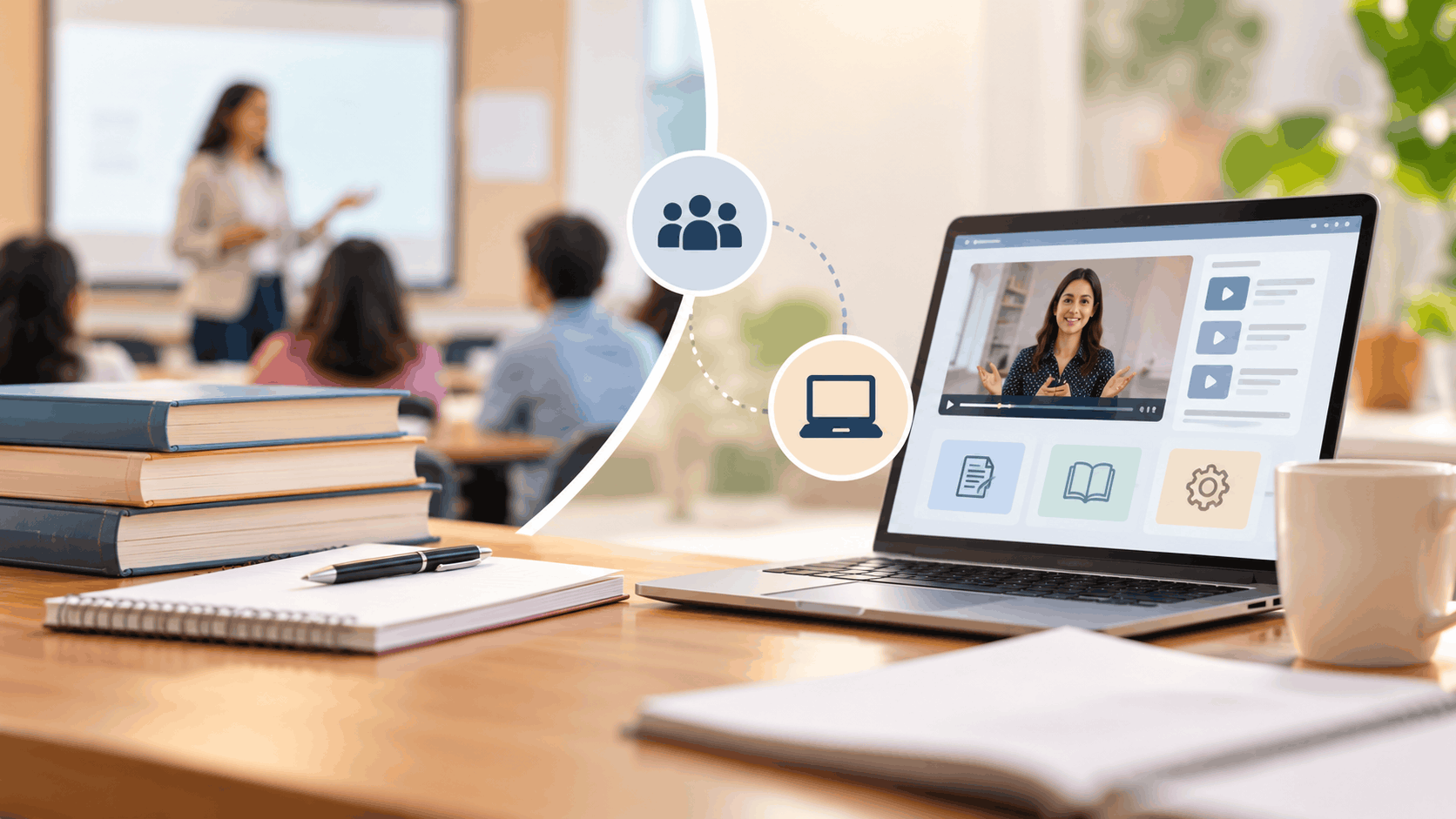
Classroom teaching on its own struggles to keep pace with how people learn today. Learners expect to revisit material on their phones and study at their own speed, yet they still need an expert in the room when they are stuck. Fully online courses solve the access problem but often lose the discussion, practice and accountability that a classroom provides. Blended learning brings the two together.
This guide explains what blended learning is, how it works, the main blended learning models, its advantages and disadvantages, and how to build a programme that delivers results.
What Is Blended Learning?
Blended learning is an approach that combines face-to-face teaching with online learning in one planned course. Part of the learning takes place in a classroom or a live session with an instructor. The rest takes place online, where learners have some control over when, where or how fast they study.
The blended learning meaning goes further than adding technology to a classroom. A teacher who shows slides on a projector is not running a blended course. The two parts must be connected, so that what a learner does online prepares for, or builds on, what happens in person.
In India, the University Grants Commission has formally recognised this approach. Its concept note on the blended mode of teaching and learning allows higher education institutions to teach up to 40 per cent of a course online and the remaining 60 per cent offline. The note makes the same point: blending is a planned combination of meaningful activities, not a simple mix of two modes.
What Is the Meaning of a Blended Mode Examination?
A blended mode examination is an assessment that combines online and offline elements. The term is used in a few ways, so it helps to know which one applies to you:
- Blended course, offline exam. Under the UGC concept note, examinations for courses taught in blended mode can be held offline, even though part of the teaching was online.
- Continuous online assessment with a final written exam. Quizzes, assignments and projects are completed online during the term, and a final paper is written at a centre.
- Choice of mode. Some institutions let candidates take the same examination either online or at a test centre.
Always check the notification from the specific university or exam body, because the rules differ.
How Does the Blended Learning Approach Work?
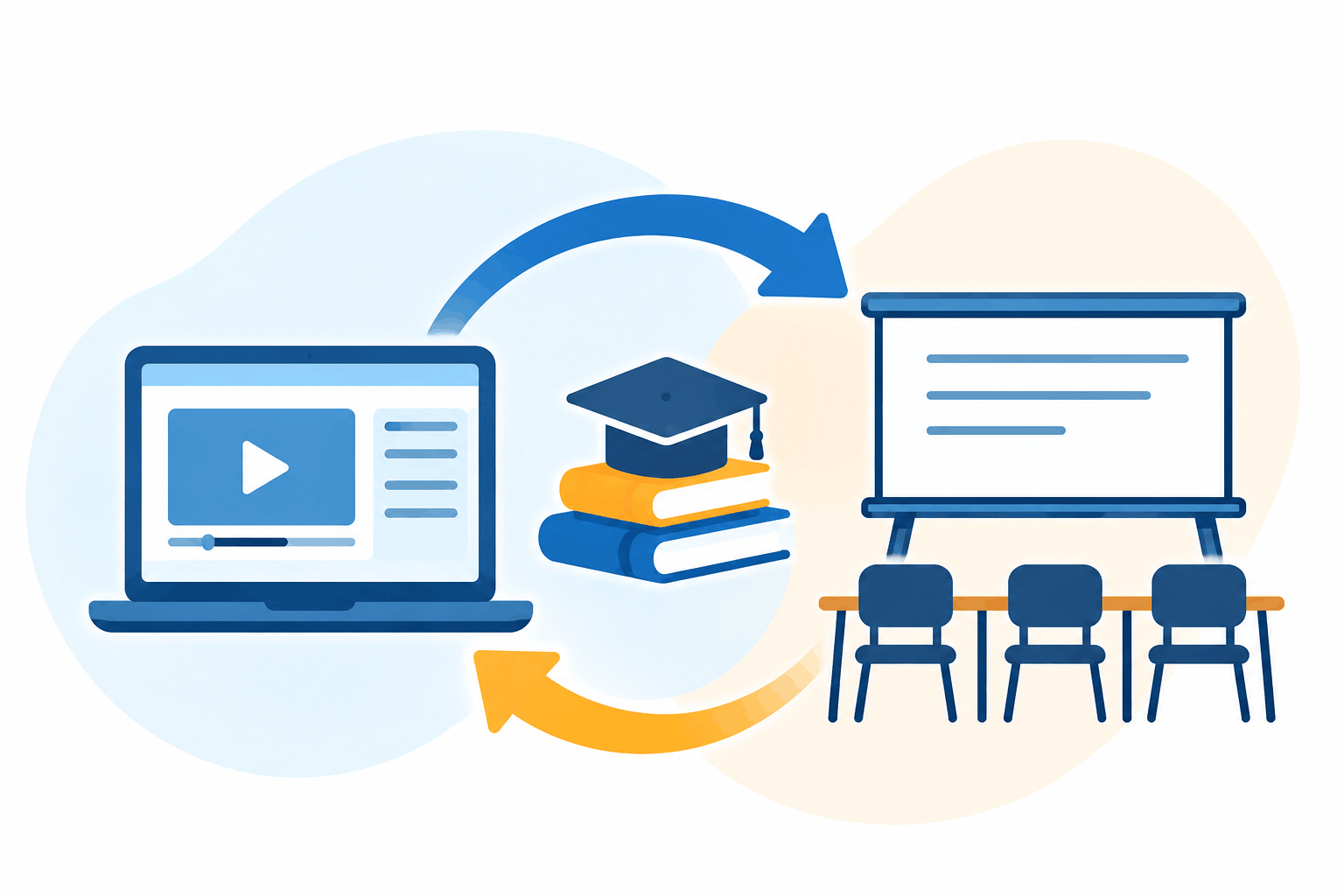
Most blended programmes follow a simple cycle:
- Learn online. Learners study core concepts through videos, readings or short modules at their own pace.
- Apply in person. Classroom or live sessions are used for discussion, problem solving, role play and feedback.
- Reinforce online. Short follow-up activities and quizzes help learners remember what they practised.
- Assess and adjust. Results from both settings show the instructor where learners need more support.
The principle is straightforward. Information moves online, and the time with an instructor is used for the work that most needs one.
What Are the Types of Blended Learning?
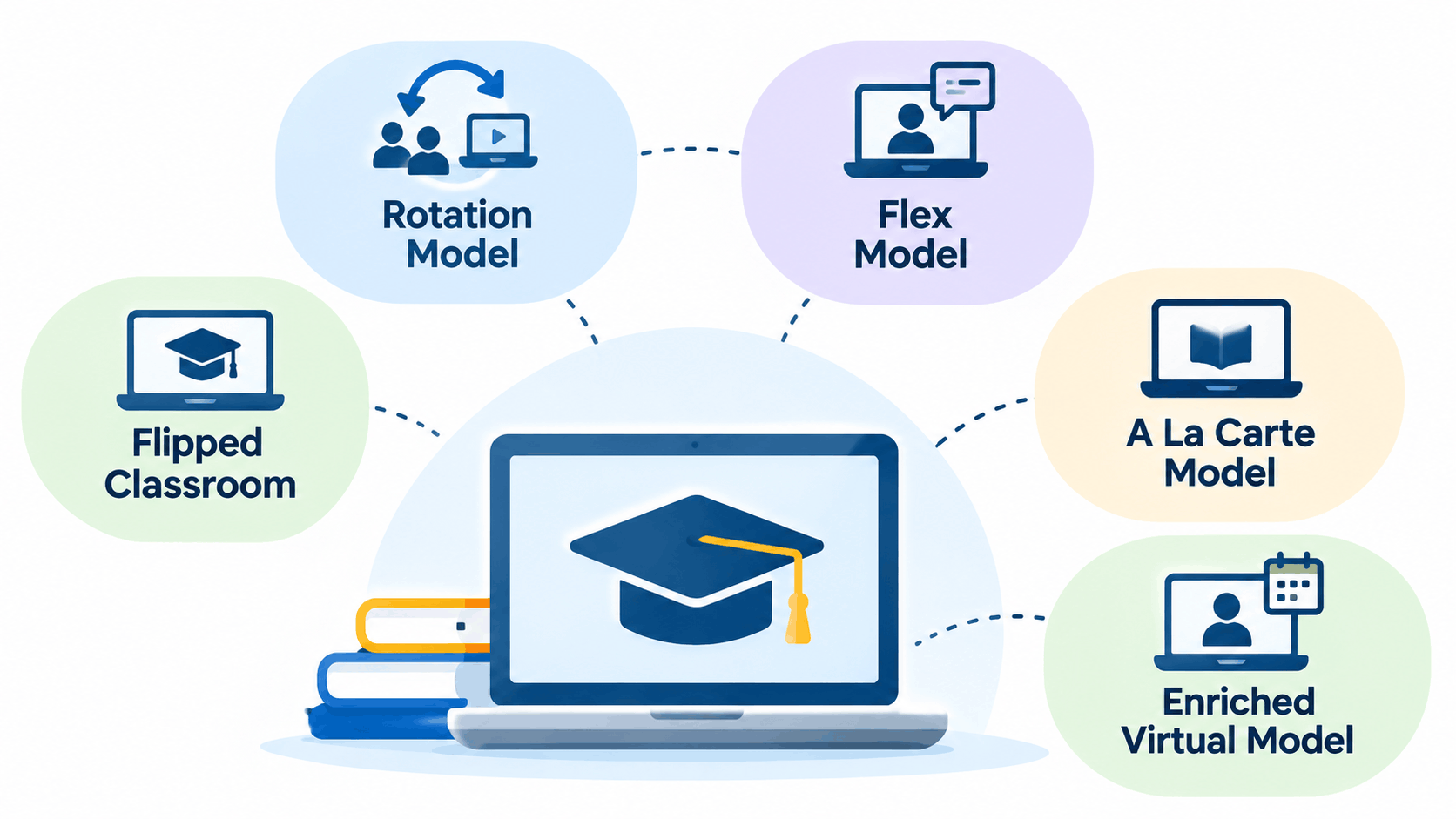
The most widely used framework for the types of blended learning comes from the Clayton Christensen Institute, which groups most programmes into four blended learning models. The first, Rotation, has four variations.
| Model | How it works | Best suited to |
|---|---|---|
| Station Rotation | Learners move between stations in one classroom, at least one of which is online | Schools and small group teaching |
| Lab Rotation | Learners move to a computer lab for the online part | Institutions with shared computer facilities |
| Flipped Classroom | Learners study content online at home and use class time for practice | Higher education and skills training |
| Individual Rotation | Each learner follows a personal schedule set by the teacher or software | Programmes with mixed ability levels |
| Flex | Online learning is the backbone, and teachers give support as needed | Self-paced and remedial programmes |
| A La Carte | Learners take one or more courses fully online alongside their regular classes | Electives and specialist subjects |
| Enriched Virtual | Most work is done online, with required in-person sessions | Part-time and working learners |
Blended learning models in corporate training
Companies often use simpler patterns. A common one is online pre-work followed by a classroom workshop. Another is a workshop followed by a series of short online refreshers. A third mixes self-paced modules with live virtual sessions for teams spread across locations.
What Are the Benefits of Blended Learning?
- Stronger results. A 2009 meta-analysis for the US Department of Education found that courses combining online and face-to-face instruction had a larger advantage over classroom-only teaching than fully online courses did. The researchers noted that extra learning time and varied methods were likely part of the reason.
- Flexibility. Learners study online on their own schedule and attend fewer, more focused sessions.
- Better use of instructor time. Trainers spend less time repeating content and more time coaching.
- Personalisation. Learners who already know a topic move ahead, while others repeat material without holding up the group.
- Lower costs. Fewer classroom days reduce spending on venues, travel and printed material.
- Clear data. Online activity shows who has completed what, which helps instructors step in early.
Blended Learning Advantages and Disadvantages: What to Weigh
The advantages above are real, but blended learning also brings challenges that should be planned for:
- Unequal access. Not every learner has a reliable device or internet connection. Offline options and mobile-friendly content reduce this gap.
- Self-discipline. Some learners fall behind on the online part. Deadlines, reminders and short modules help.
- Design effort. A good blended course takes more planning than a lecture series, because the two parts must work together.
- Instructor skills. Teachers need to move from presenting content to coaching. This shift needs training and support.
- Disconnected parts. When the online and classroom sessions do not refer to each other, learners treat them as two separate courses.
Most of these problems come from design rather than from the approach itself.
Examples of Blended Learning
- School. A mathematics teacher assigns a short video on fractions for homework. In class, students solve problems in small groups while the teacher works with those who are struggling.
- University. A college teaches the theory of a commerce course online under the UGC's 40 per cent provision and uses campus sessions for case discussions and presentations.
- Corporate onboarding. New employees complete policy and product modules before their first day. The first week is spent shadowing colleagues, and microlearning modules of a few minutes each reinforce key points over the following month.
How Do You Design an Effective Blended Learning Programme?
- Start with outcomes. Define what learners must be able to do at the end, not which content they must see.
- Decide what goes where. Place knowledge and explanation online, and keep practice, discussion and feedback for live sessions.
- Connect the two parts. Every classroom session should build on the online work that came before it.
- Choose a model. Match the model to your learners, schedule and facilities.
- Make content accessible. Use captions, readable layouts and formats that work on phones.
- Measure and improve. Track completion and assessment results, and revise the weak parts.
Strong instructional design is what holds these steps together. It decides the sequence, the activities and the assessments, so that each part of the course has a clear purpose.
How Can Margo Learning Help With Blended Learning?
A blended programme is only as effective as the content inside it. Margo Learning's instructional designers and subject experts build the online components of blended courses, including interactive modules, videos, microlearning and assessments, designed to connect with your classroom sessions. Contact Margo Learning to discuss your learners, your goals and the right blend for your programme.
Frequently Asked Questions
Blended learning is a way of teaching that combines classroom or live sessions with online study. Learners cover some material online at their own pace and use time with the instructor for practice and discussion.