
A well written multiple choice question can show whether a learner has understood an idea in under a minute. A poorly written one can reward guessing, confuse capable learners and give you misleading results. The difference lies in how the question is built.
This guide explains what an MCQ is, the main types, examples you can adapt, the advantages and the practices that make questions fair and useful.
What Is an MCQ Question?
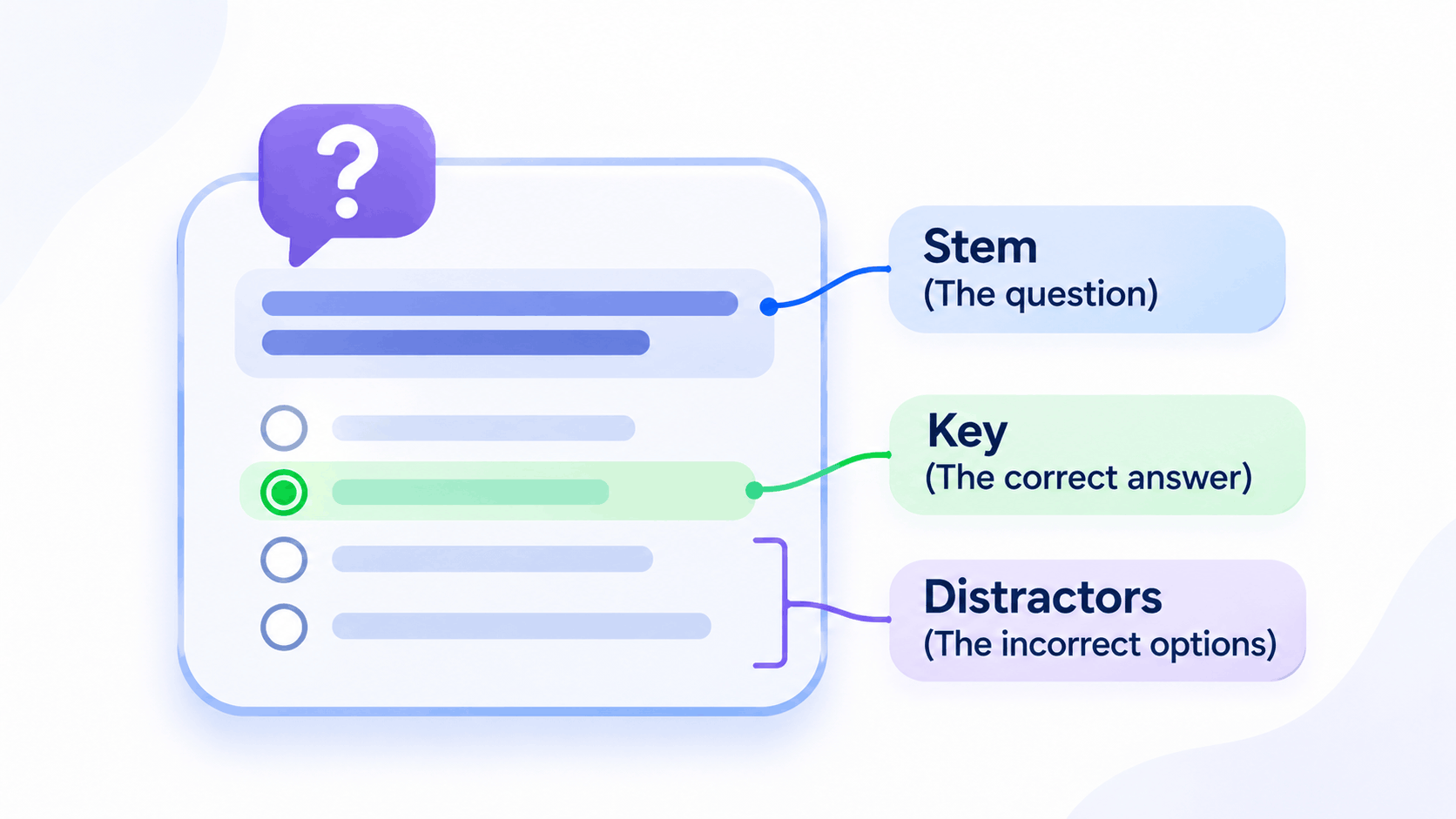
An MCQ, or multiple choice question, asks a learner to select the correct answer from a set of choices. It has three parts. The stem is the question or statement. The key is the correct answer. The distractors are the incorrect options, written to look reasonable to a learner who has not yet mastered the topic.
Because the learner selects an answer instead of writing one, MCQs can be scored quickly and consistently. Schools, universities, employers and exam bodies all rely on them for this reason.
Well written MCQs can test understanding and application as well as recall, for example by describing a short situation and asking for the best response.
What Are the Types of MCQ Questions?
The format you choose should match what you want to measure. The table shows the most common types.
| Type | How it works | Best used for |
|---|---|---|
| Single best answer | One correct option from three or four | Checking knowledge and understanding |
| Multiple response | Two or more options are correct | Testing lists, features or steps |
| True or false | Two options, one correct | Checking a single fact or statement |
| Scenario based | A short case followed by a question | Testing application and judgement |
| Assertion and reasoning | The learner judges a statement and whether a given reason explains it | Testing cause and effect |
| Match the following | Items in one column are paired with items in another | Linking terms, definitions or examples |
| Image based | The question refers to a diagram, chart or photograph | Subjects where visuals carry meaning |
Single best answer suits most checks of knowledge. Scenario based questions take longer to write, but they show whether learners can use what they know.
What Are Some Examples of Multiple Choice Questions?
Example 1: Single best answer
Which statement best describes a distractor in a multiple choice question?
A. The correct answer B. An incorrect option that seems plausible to a learner who has not mastered the topic C. The text of the question D. The feedback shown after the learner answers
Correct answer: B. This question checks whether the learner knows a term.
Example 2: Scenario based
A trainer teaches a new process in one two hour session. Two weeks later, most learners cannot recall the steps. Which change is most likely to improve long term retention?
A. Repeat the same two hour session immediately B. Split the content into short sessions over several days and add practice questions C. Add more text to each slide D. Remove the final quiz
Correct answer: B. Spreading learning over time and practising recall both support memory. This question asks learners to apply an idea, which makes it stronger than a simple definition.
What Are the Advantages of Multiple Choice Questions?
- Scoring is fast and consistent. Every learner is marked against the same key, so results do not depend on who marks the paper.
- They cover a lot of content. A learner can answer many questions in a short time, so one assessment can sample many topics.
- They suit large groups and digital delivery. Online quizzes score automatically and give feedback straight away. Test preparation providers rely on large question banks, and Margo Learning's test prep and competitive exams content includes question banks and full mock test sets with answer keys and worked solutions.
- They support practice. Low stakes quizzes let learners retrieve and apply what they have studied before a formal test.
- They produce useful data. You can see which questions are too easy, too hard or unclear, and which topics need more teaching.
MCQs also have limits. Learners can guess, good distractors take effort to write, and the format cannot show how well someone writes, speaks or builds something. Use MCQs alongside other methods where those skills matter.
What Are the Best Practices for Writing Multiple Choice Questions?
The Yale Center for Teaching and Learning offers a useful guide to designing quality multiple choice questions. These practices draw on it and on widely used item writing guidelines.
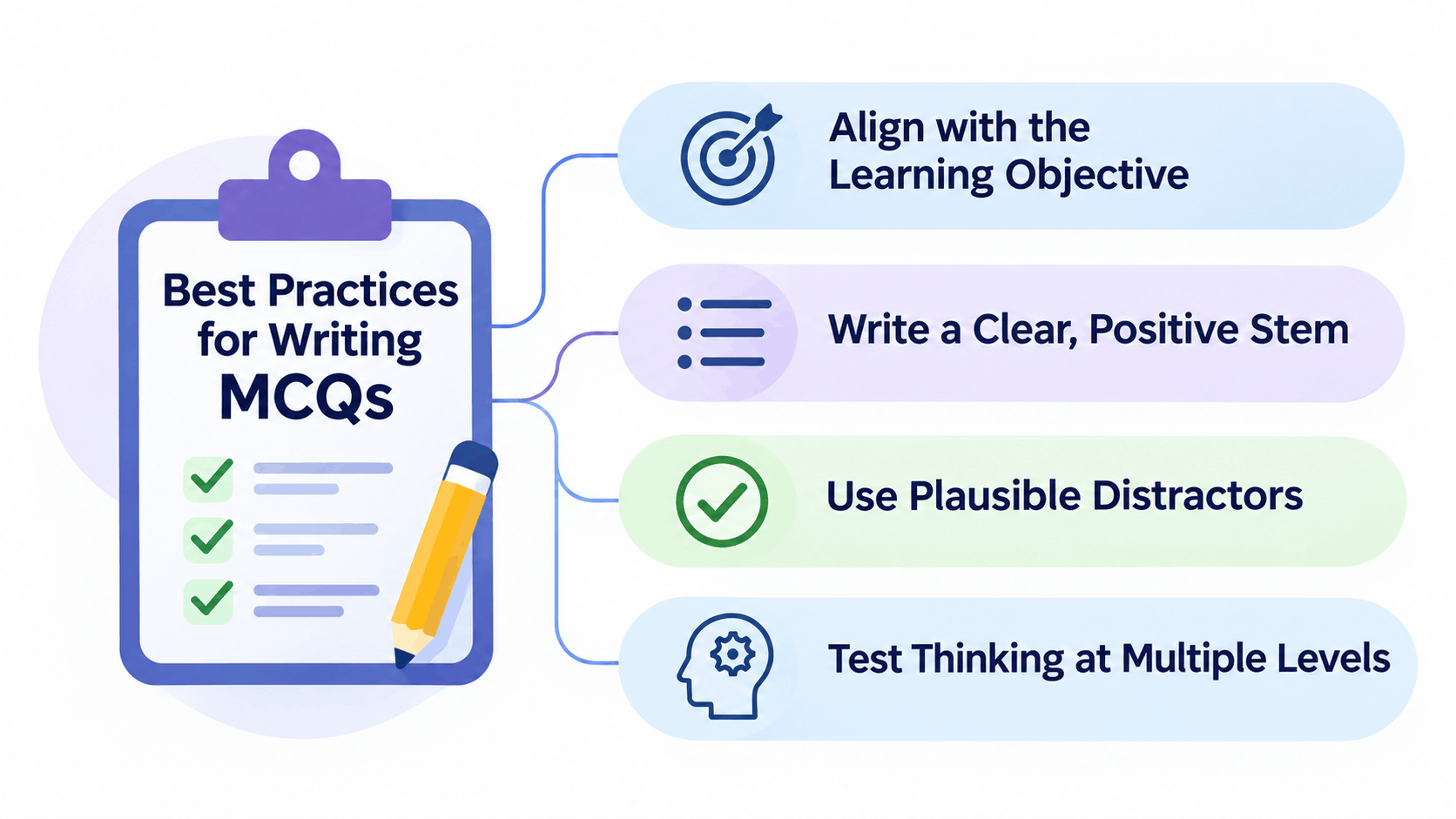
- Start from the learning objective. Every question should check something your course set out to teach. Margo Learning's instructional design solutions help you set objectives first, so your questions follow from them.
- Put the central idea in the stem. State the question clearly and briefly, and phrase it positively. Avoid words such as "not" and "except", which cause errors unrelated to knowledge.
- Make one answer clearly correct. Experts should agree on the key, and the other options should be clearly wrong.
- Write plausible distractors. Base them on common mistakes, so that choosing one tells you something about the learner's thinking.
- Keep the options alike. Match their length, grammar and detail, and avoid clues such as "always" or "never".
- Use three or four options. Research on item writing suggests three good options are often adequate. Add a fourth only if it is plausible.
- Avoid "all of the above" and "none of the above". Vary the position of the correct answer across the test.
- Test thinking at several levels. Use Bloom's Taxonomy to mix recall questions with application and analysis, and use scenarios for the higher levels.
- Review the results. Check how many learners answer each question correctly and whether strong learners do better than weaker ones. Revise or remove questions that do not separate the two.
How Can Margo Learning Help You Create Assessments?
Writing hundreds of accurate, well calibrated questions takes subject knowledge and a careful review process. Margo Learning's assessment creation services cover MCQs, multi select, true or false, fill in the blank, match the following, numerical and assertion reasoning questions. Each item is written by a subject expert, reviewed in stages and tagged by difficulty, topic and cognitive level. You receive answer keys and worked solutions, with files in formats such as Excel, CSV, SCORM or xAPI. Contact Margo Learning to discuss your assessment needs and agree the next step.
Frequently Asked Questions
Three or four. A fourth option is useful only when it is a plausible distractor. Weak options add reading time without telling you anything about the learner.