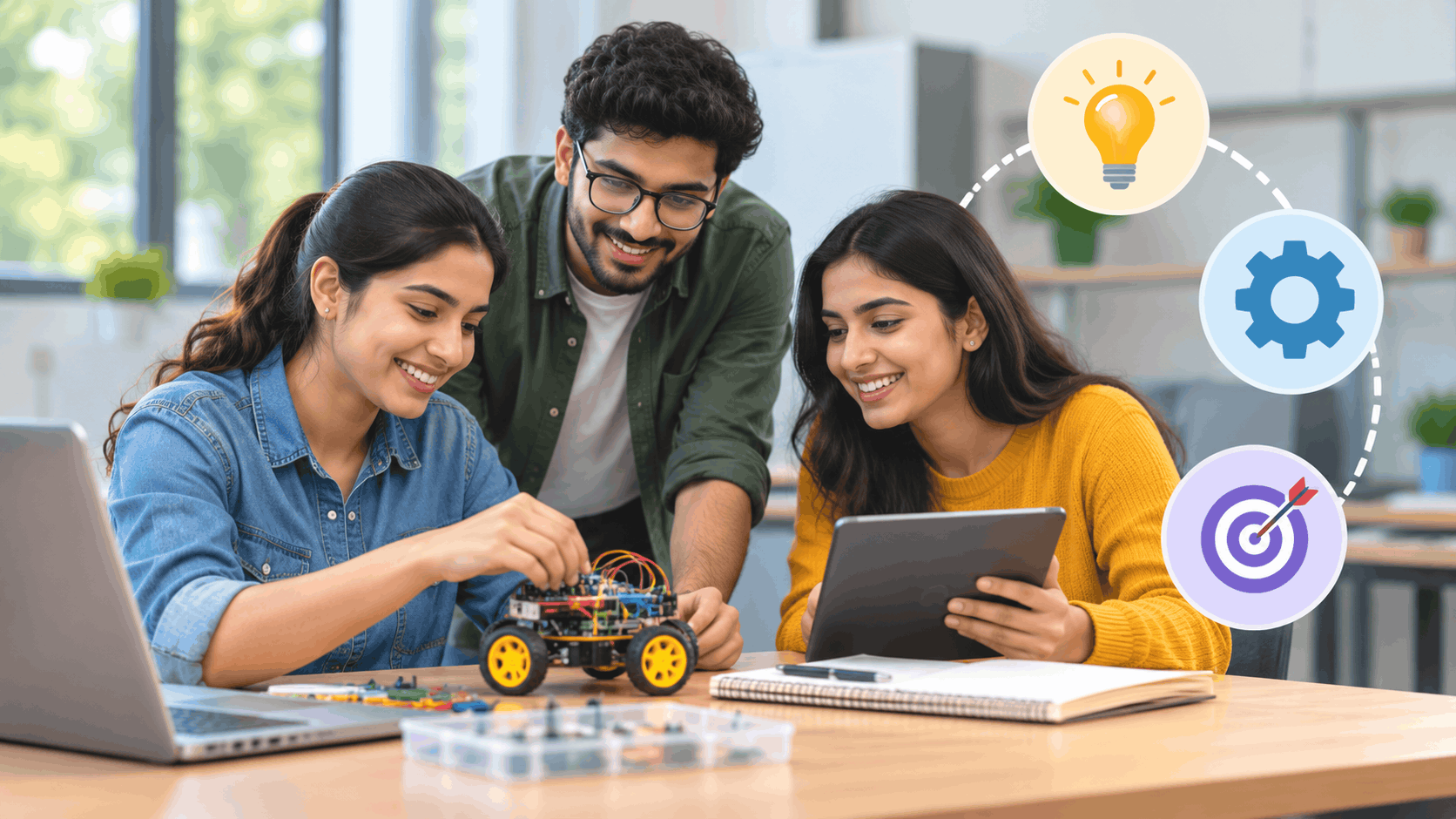
Most people cannot remember much of what they were told in a lecture five years ago. Yet they can describe in detail the first time they handled a real customer, ran an experiment that went wrong, or fixed something with their own hands. The experience stayed with them because they were part of it.
Experiential learning builds education around that simple observation. This article explains what it is, the model behind it, the main types, its benefits and how it can be used in classrooms, online courses and workplaces.
What Is Experiential Learning?
The simplest experiential learning definition is learning by doing, followed by reflecting on what was done. Learners take part in a real or realistic activity, think about what happened, draw a lesson from it and then apply that lesson the next time.
The reflection is what separates experiential learning from mere activity. A student who spends a week on an internship without ever thinking about what went well or badly has had an experience, but may not have learned much from it. The experiential learning meaning lies in the combination: experience gives the material, and reflection turns it into understanding.
The idea has a long history. The philosopher and educator John Dewey argued in the early twentieth century that education should be rooted in real experience. The educational theorist David Kolb later turned these ideas into the model most widely used today.
The Experiential Learning Process: Kolb's Cycle
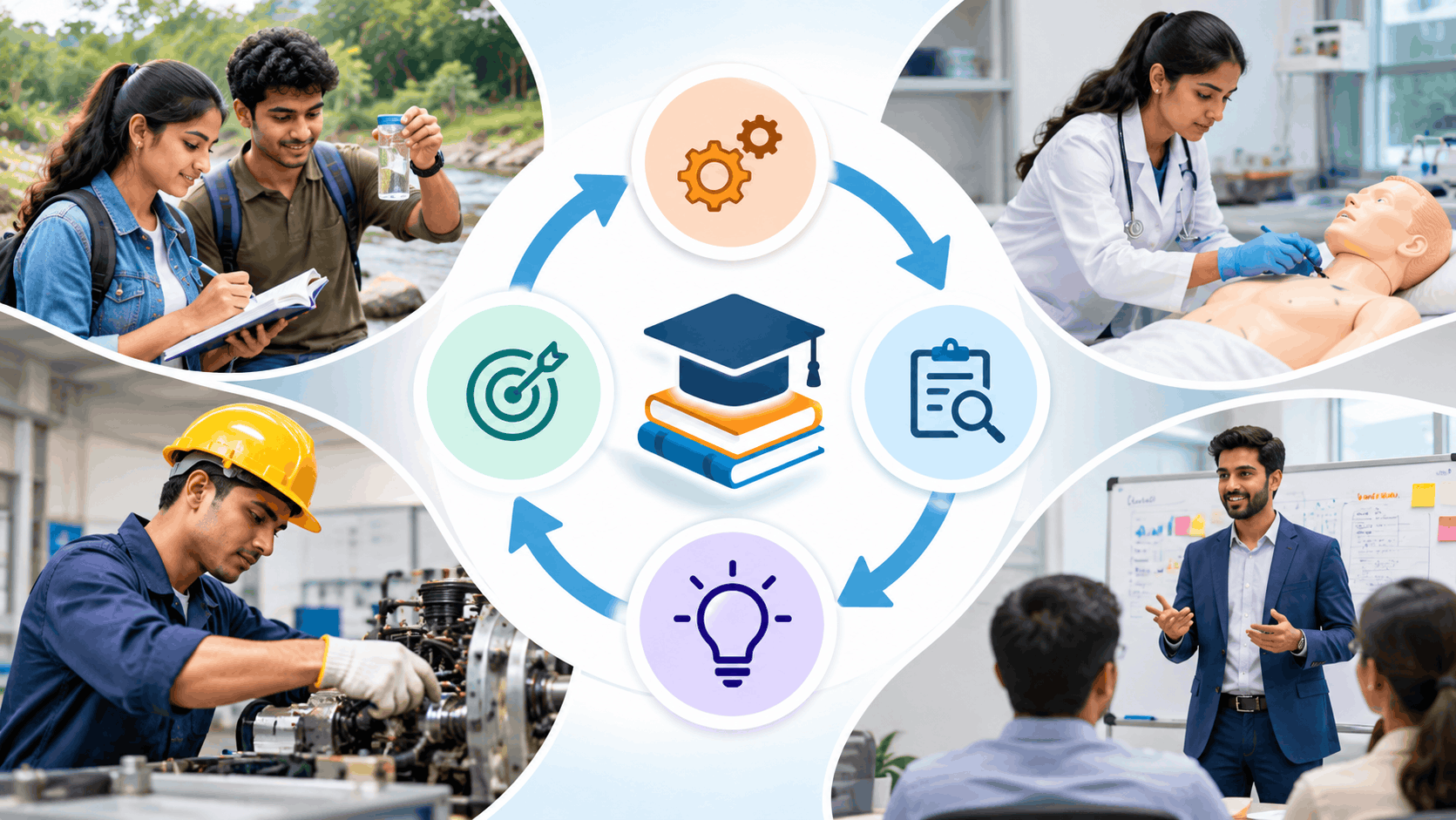
Kolb described the experiential learning process as a cycle with four stages. Learning can begin at any point, but it is most complete when the learner passes through all four.
It usually starts with a concrete experience. The learner does something: handles a task, takes part in a simulation, visits a site or works on a real problem.
Then comes reflective observation. The learner steps back and considers what happened. What went as expected? What surprised them? How did others respond?
The third stage is abstract conceptualisation. Here the learner makes sense of the reflection, linking it to ideas, principles or theory. This is the point where a specific experience becomes a general lesson that can be used elsewhere.
Finally, there is active experimentation. The learner tests the new understanding in a fresh situation, which creates a new experience, and the cycle begins again.
Consider a trainee nurse who struggles to calm an anxious patient. Afterwards, with a mentor, she reflects on what she said and how the patient reacted. She connects this to what she has studied about communication and anxiety. The next day, she tries a different approach with another patient. Each turn of the cycle makes her a little more capable.
Kolb also proposed four learning styles linked to the cycle. These are often quoted, but research has not shown that matching teaching to a preferred style improves results. The cycle itself is the more useful part of his work.
What Are the Types of Experiential Learning?
The types of experiential learning differ mainly in how real the experience is and where it takes place.
The most direct forms happen in real working environments. Internships, apprenticeships and on-the-job training place learners in actual roles, with real consequences. Apprenticeships in particular combine practical work with structured study, which makes them a natural fit for the full Kolb cycle.
Project-based learning sits close behind. Learners work on an extended task with a real outcome, such as designing a product, solving a problem for a local organisation or producing a research report. Service learning is a related form in which students apply what they are studying to help a community, then reflect on the experience.
Where real practice is too risky, costly or rare, simulations take its place. Pilots train in flight simulators, medical students practise on mannequins, and managers work through business simulations. Role plays and case studies work in a similar way at lower cost, asking learners to act out or analyse realistic situations.
Field work and site visits, such as a geography field trip or a visit to a manufacturing plant, give learners first-hand exposure to what they have only read about.
Online courses can offer experiential learning too. Branching scenarios, virtual labs and interactive video, in which learners make decisions and see the consequences, let people practise judgement safely and at their own pace.
What Are the Benefits of Experiential Learning?
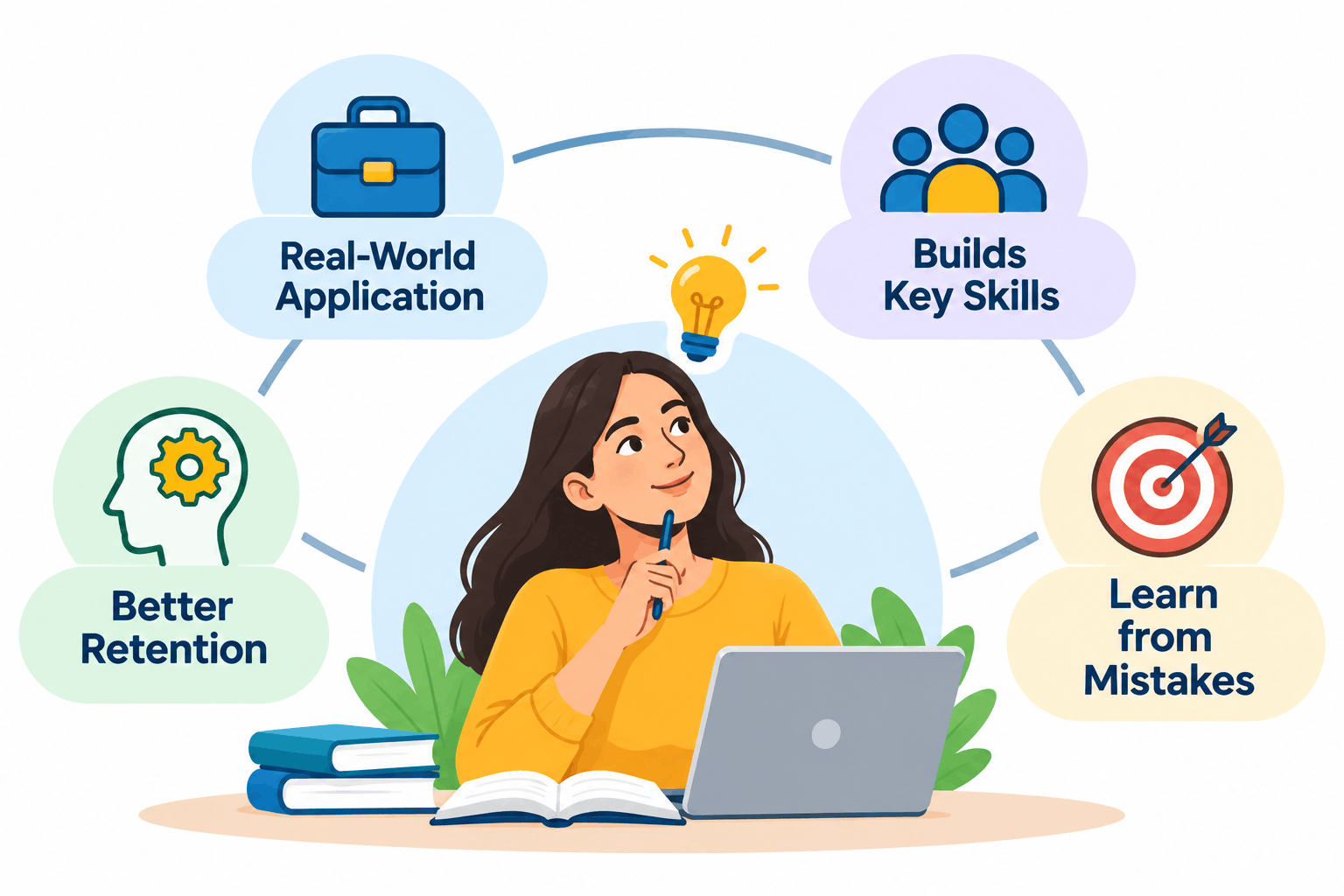
The most practical benefit is that learning transfers to real work. When people have already done something in a realistic setting, they are far more confident and capable when they meet it for real. This is why practical training is central to fields such as medicine, aviation and the skilled trades.
Experiential learning also tends to stay with people longer. An experience carries emotion, context and personal involvement, and these make it easier to recall than a list of facts read from a page.
It builds skills that are difficult to teach directly. Problem solving, teamwork, communication and decision making under pressure develop through practice and reflection, not through explanation alone.
Mistakes become useful. In a simulation or a supervised placement, an error is a learning opportunity rather than a costly failure, and reflecting on it often teaches more than getting things right the first time.
There are challenges. Experiential programmes take more time and planning than lectures, and they need skilled facilitators to guide the reflection. Assessment is also harder, because learners' experiences differ. Without structured reflection, the activity can become enjoyable but shallow.
Examples of Experiential Learning
In schools, a science class that tests the quality of water from a local river learns far more about chemistry and the environment than one that reads about it. Students collect samples, run tests, discuss their results and suggest what could be done.
In colleges, business students who run a small venture for a term, with a real budget and real customers, experience the full cycle of planning, mistakes and adjustment.
In vocational and professional skilling, experiential learning is often the core of the programme. Electricians, technicians, healthcare workers and hospitality staff learn through workshops, demonstrations and supervised practice, supported by short theory modules.
In companies, new managers might work through a simulated performance conversation with an actor or a branching scenario, then discuss with a coach what worked and what they would change.
How Can Margo Learning Help With Experiential Learning?
Experiential learning depends on realistic practice and well-guided reflection. Margo Learning's instructional designers, subject experts and video team build branching scenarios, interactive videos, simulations and case-based activities for schools, colleges, skilling programmes and companies, each designed around clear learning outcomes. Contact Margo Learning to discuss how to bring more practice and less passive content into your courses.
Frequently Asked Questions
It is learning by doing something and then reflecting on it. Learners take part in an activity, think about what happened and apply the lesson the next time.