Picture a class of thirty students working through the same chapter on algebra. A handful finished the exercises in ten minutes and are now bored. Most are getting there. Four or five are stuck on a concept from two chapters ago, and the lesson is moving on without them. The teacher can see all of this but cannot be in thirty places at once.
Adaptive learning was developed to deal with exactly this problem. This article explains what adaptive learning is, how it works, the types you will come across, its benefits and where it is used today.
What Is Adaptive Learning?
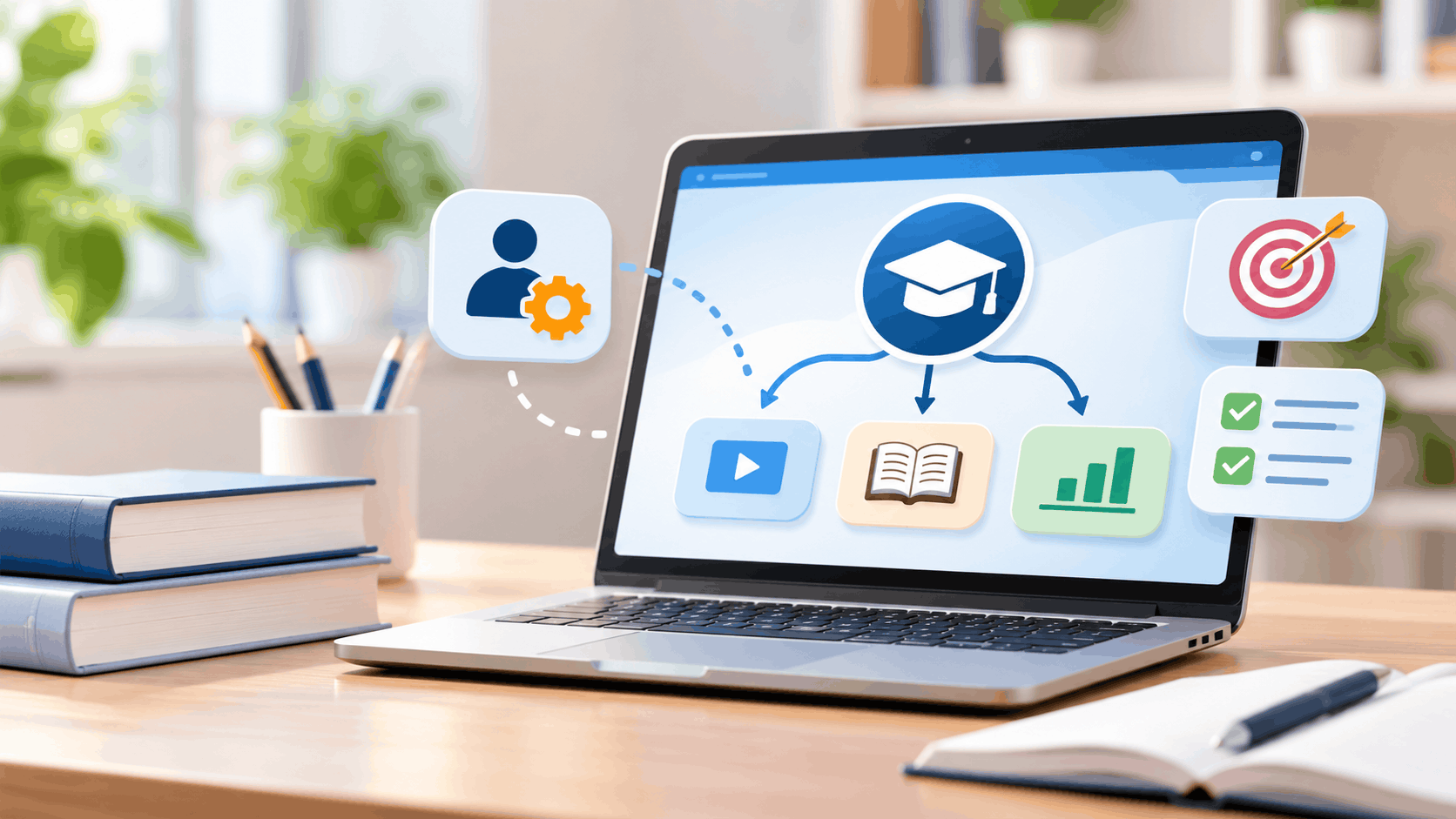
Adaptive learning is a way of delivering education in which the content, its difficulty or its order changes for each learner based on how that learner is performing. Instead of every student following the same path, the system watches the answers they give, works out what they already know, and decides what they should see next.
In plain terms, the adaptive learning meaning comes down to one idea: the course responds to the learner, rather than the learner fitting the course. A student who answers three questions on fractions correctly moves on. A student who gets them wrong is shown a simpler explanation, a worked example or a short video, then given another attempt.
Good human tutors have always taught this way. They notice confusion, step back and try a different explanation. What is new is that software can now do some of this for hundreds or thousands of learners at the same time, and keep a detailed record of what each one has mastered.
How Does Adaptive Learning Work?
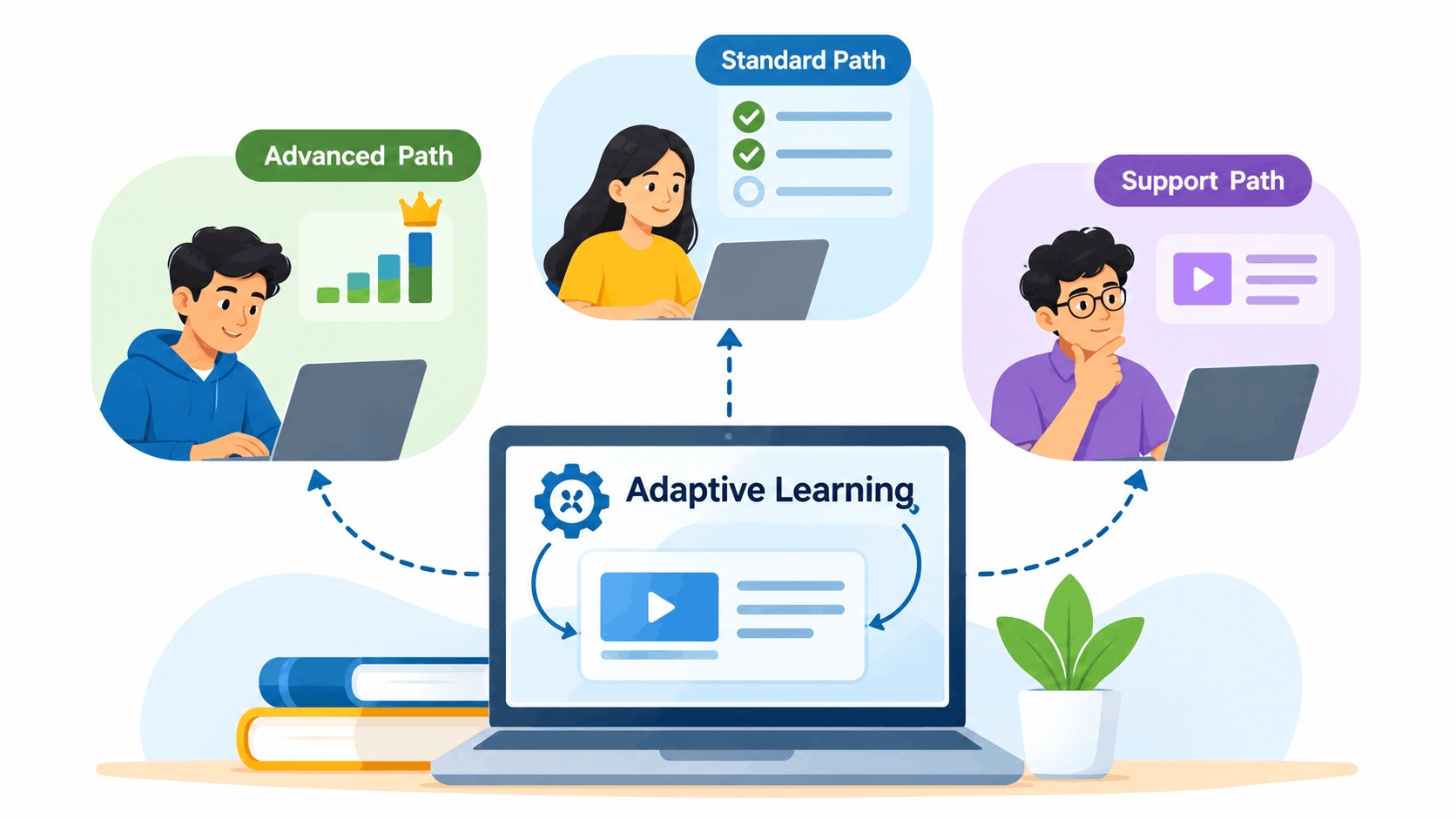
Every adaptive system, however simple or advanced, follows the same basic loop.
It begins by finding out where the learner stands. This might be a short diagnostic test at the start, or it might simply be the first few questions of a lesson. Each answer, along with how long it took and how many attempts were needed, tells the system something about what the learner understands.
The system then compares that evidence against a map of the subject. Content in an adaptive course is broken into small, clearly defined skills, each linked to the ones that come before and after it. If a learner struggles with solving equations, the system can check whether the real gap lies earlier, in handling negative numbers, and send them back to that point.
Finally, it chooses what comes next and keeps adjusting. Every new answer updates the picture, so the path is never fixed. Two learners who start the same course on the same day may finish it having seen quite different material.
What Are the Types of Adaptive Learning?
The types of adaptive learning are usually described by what the system changes. Most platforms combine more than one.
Adaptive content. The material itself changes. A learner who is struggling might receive a hint, a simpler explanation or extra practice, while a confident learner skips ahead to harder problems. The topic stays the same, but the support around it does not.
Adaptive assessment. Each question is chosen based on the answer to the one before. A correct response leads to a harder question and an incorrect one to an easier question, which allows the test to measure ability accurately with fewer questions. Some well-known entrance examinations, including the GRE, use a form of this by adjusting the difficulty of later sections according to performance in earlier ones.
Adaptive sequencing. The order of lessons changes. Rather than moving through chapters one to ten, each learner follows a route built around their own gaps and strengths.
It also helps to know how the decisions are made. Simpler systems are rule-based: a course designer writes conditions such as "if the learner scores below 60 per cent, show the revision module". More advanced systems use algorithms and artificial intelligence that learn from the data of many learners to predict what will help each one. Rule-based adaptivity is easier to build and explain, which is why many corporate courses start there.
What Are the Benefits of Adaptive Learning?
The most immediate benefit is time. A learner who already understands a topic does not have to sit through it again, and in workplace training that can remove hours from a course. Employees who joined from a similar role can test out of the basics and spend their time on what is genuinely new to them.
The second benefit matters more for weaker learners. In a traditional class, a gap in understanding often goes unnoticed until an examination exposes it, by which point several later topics have been built on top of it. An adaptive system catches the gap early and returns to it before moving on.
There is a motivational side as well. Work that is far too easy is dull, and work that is far too hard is discouraging. By keeping each learner close to the edge of what they can manage, adaptive learning keeps them challenged without leaving them lost.
Teachers and trainers gain something too. Instead of a single test score at the end of a term, they can see which skills each learner has mastered and where a group is consistently stuck. That makes it far easier to plan the next live session around real needs.
Adaptive learning has limits, and they are worth stating. It depends on content that has been carefully broken down and tagged, which takes time to build. It works best for subjects with clear right and wrong answers, such as mathematics, science, languages and compliance rules, and less well for open discussion or creative work. It also supports teachers rather than replacing them.
Examples and Applications of Adaptive Learning
In schools, adaptive learning is most common in mathematics and reading practice. Students work through exercises on a tablet or laptop, and the software adjusts the difficulty as they go. The teacher receives a summary showing who needs help with which skill, and can group students for targeted support during the next class.
Test preparation is one of the strongest use cases. Students preparing for competitive examinations face large syllabuses and limited time. An adaptive practice platform identifies their weakest topics from mock tests and directs more practice there, instead of asking them to revise everything equally. This depends on a large, well-tagged question bank, and the quality of those questions largely decides how useful the system is. Margo Learning's assessment creation services build exactly this kind of question bank, with each item mapped to a skill and a level of difficulty.
In higher education, universities use adaptive courseware in large introductory courses, where one lecturer may be responsible for hundreds of students. Learners complete adaptive assignments before lectures, and the lecturer uses the class data to decide which topics need more attention.
In corporate training, adaptive learning is used for onboarding, product knowledge and compliance. An employee who passes a pre-assessment on data protection might receive a ten-minute refresher, while a new joiner completes the full programme. This works particularly well when content is built as short, self-contained units, because the system can select and combine them freely. Well-designed microlearning modules suit this approach.
How Can Margo Learning Help You Build Adaptive Learning?
An adaptive platform is only as good as the content it has to choose from. It needs learning objectives mapped skill by skill, questions written at several levels of difficulty, and short lessons that can be served in different orders. Margo Learning's instructional designers and subject experts build this content for schools, test preparation providers, universities and companies, in formats that work with your existing LMS. Contact Margo Learning to discuss your learners and how an adaptive approach could work for them.
Frequently Asked Questions
Adaptive learning is a method in which a course changes to suit each learner. It checks what the learner knows from their answers and then decides what to show next, so stronger learners move ahead and others get extra support.