
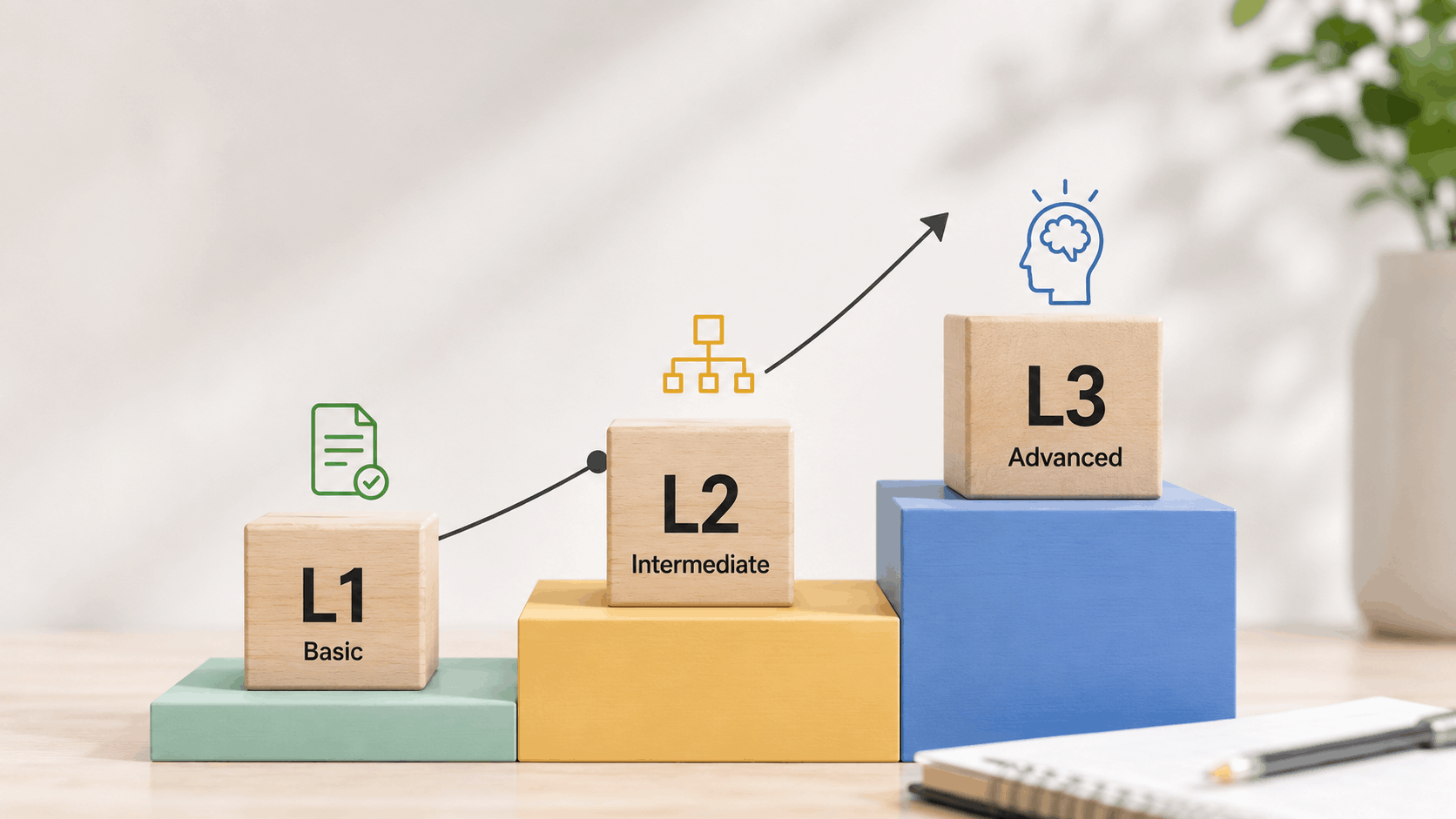
What the L1, L2, and L3 eLearning complexity levels actually mean, with cost, build-time, and use-case guidance to help you pick the right one.
What "L1, L2, L3" Actually Means
Ask five different vendors what "L2 eLearning" means and you will often get five slightly different answers. The L1/L2/L3 framework (sometimes extended to L4) started as shorthand inside the eLearning industry to describe how interactive a course is, but because there is no single governing standard, the labels have drifted. Broadly, though, the levels describe a spectrum from passive, read-and-click content through to fully simulated, decision-driven experiences.
Understanding what each level genuinely includes and, more importantly, what it does not is the difference between briefing a vendor accurately and discovering three weeks into development that "interactive" meant something very different to you than it did to them.
The Three Levels, Side by Side
| Attribute | L1 | L2 | L3 |
|---|---|---|---|
| Interactivity | Click-to-reveal, page navigation | Drag-and-drop, scenarios, knowledge checks | Branching simulations, decision-consequence paths |
| Media used | Text, static images | Custom graphics, basic animation, audio narration | Custom animation/video, voiceover, interactive avatars |
| Learner control | Linear or semi-linear | Learner-paced with some choice | Learner-driven, outcomes vary by decision |
| Typical build time | 1–2 weeks per hour of content | 3–5 weeks per hour of content | 6–10+ weeks per hour of content |
| Best suited for | Policy updates, awareness content, reference material | Skills training, process training, compliance with application | Judgement-based roles, high-stakes decisions, soft-skills practice |
Development time and cost scale with the level, but so does the depth of behavioural change the content can realistically drive. The mistake most organisations make is picking a level based on budget alone, without checking whether that level can actually deliver the learning outcome they need.
L1: Page-Turner / Presentation-Style eLearning
L1 is the base level: largely linear content built around text, static images, and simple click-to-reveal or click-to-continue interactions. There is little to no branching, and assessment (if present at all) is usually a straightforward knowledge check at the end.
L1 is not "bad" or "cheap" content, it is the right tool for a specific job:
- Policy rollouts and awareness communications where the goal is exposure, not skill-building
- Reference material learners will revisit rather than complete once
- Content with a short shelf life that will be revised again soon
- Situations with genuinely tight budget or timeline constraints where some content is better than none
Where L1 fails is when it gets used for content that actually requires behaviour change, such as compliance training that needs to influence real decisions on the job. Passive content produces passive learning.
L2: Interactive eLearning
L2 introduces genuine interactivity: drag-and-drop exercises, short branching scenarios, simulated conversations with two or three decision points, and knowledge checks that adapt slightly based on learner responses. Custom graphics and light animation typically replace stock imagery, and audio narration is standard rather than optional.
L2 is the level most corporate skills and process training should sit at, because it asks learners to apply a concept, not just recognise it. Good candidates for L2 include:
- Process and systems training where learners need to practise a sequence of steps
- Compliance training that needs to demonstrate applied understanding, not just completion
- Product knowledge training with realistic customer-interaction scenarios
- Onboarding content that combines information delivery with early skill practice
L2 sits at the point of diminishing returns for a lot of content: it delivers most of the behavioural impact of L3 at a meaningfully lower cost and build time, which is why it is the default recommendation for the majority of corporate L&D catalogues.
L3: Simulation-Based / Advanced Interactive eLearning
L3 is fully learner-driven: branching simulations where each decision genuinely changes the path and outcome, custom animation or video, interactive avatars or characters, and often a scoring or consequence system that mirrors real-world stakes. This is where content stops "explaining" and starts "rehearsing."
L3 earns its cost when the training is for:
- High-stakes judgement calls, such as safety-critical procedures or clinical decision-making
- Leadership and soft-skills development, where practising a difficult conversation matters more than reading about one
- Sales negotiation training where outcomes genuinely diverge based on approach
- Any scenario where the cost of a real-world mistake is high enough to justify simulated practice first
L3 is expensive to build well and easy to build badly. A branching structure with dozens of paths but shallow, generic consequences delivers a worse learner experience (and a worse return) than a tightly scoped L2 module. Scope and instructional design discipline matter more at this level than at any other.
How to Choose the Right Level
- Start with the behaviour, not the topic. Define exactly what the learner needs to be able to do differently after completing the content, not just what they need to know.
- Match the level to the stakes. Low-stakes, low-frequency content rarely justifies L3 investment. High-stakes, judgement-heavy content rarely gets the outcome it needs from L1.
- Check the content's shelf life. Content that will be revised again within 12–18 months should generally not be over-built; the rebuild cost compounds quickly at higher levels.
- Audit your existing library before committing. Many organisations already have L1 content sitting where L2 is needed, and L3 budget allocated to content that would perform just as well at L2.
- Pilot before you scale. For a large curriculum, build one module at the proposed level, test it with real learners, and validate the level choice before committing the full budget.
Common Mistakes to Avoid
- Choosing a level based on what a previous vendor delivered rather than what the current content actually needs
- Treating "L2" and "L3" as marketing terms without agreeing a concrete definition of what each includes, in writing, before development starts
- Building L3 simulations for content that will be outdated before the investment pays back
- Underestimating how much instructional design time (not production time) L3 content genuinely requires
- Assuming higher levels are always "better," rather than matching the level to the outcome
The Bottom Line
There is no universally "correct" level, only the level that is correct for a specific learning objective, audience, and set of constraints. The most effective content strategies use a deliberate mix: L1 for reference and awareness, L2 as the workhorse for the majority of skills and process training, and L3 reserved for the judgement-heavy content where simulated practice genuinely changes real-world outcomes.
Margo Learning works with clients to make this call project by project rather than defaulting to a single level across an entire catalogue, because the right complexity level is what makes the difference between content that gets completed and content that actually changes what learners do.