
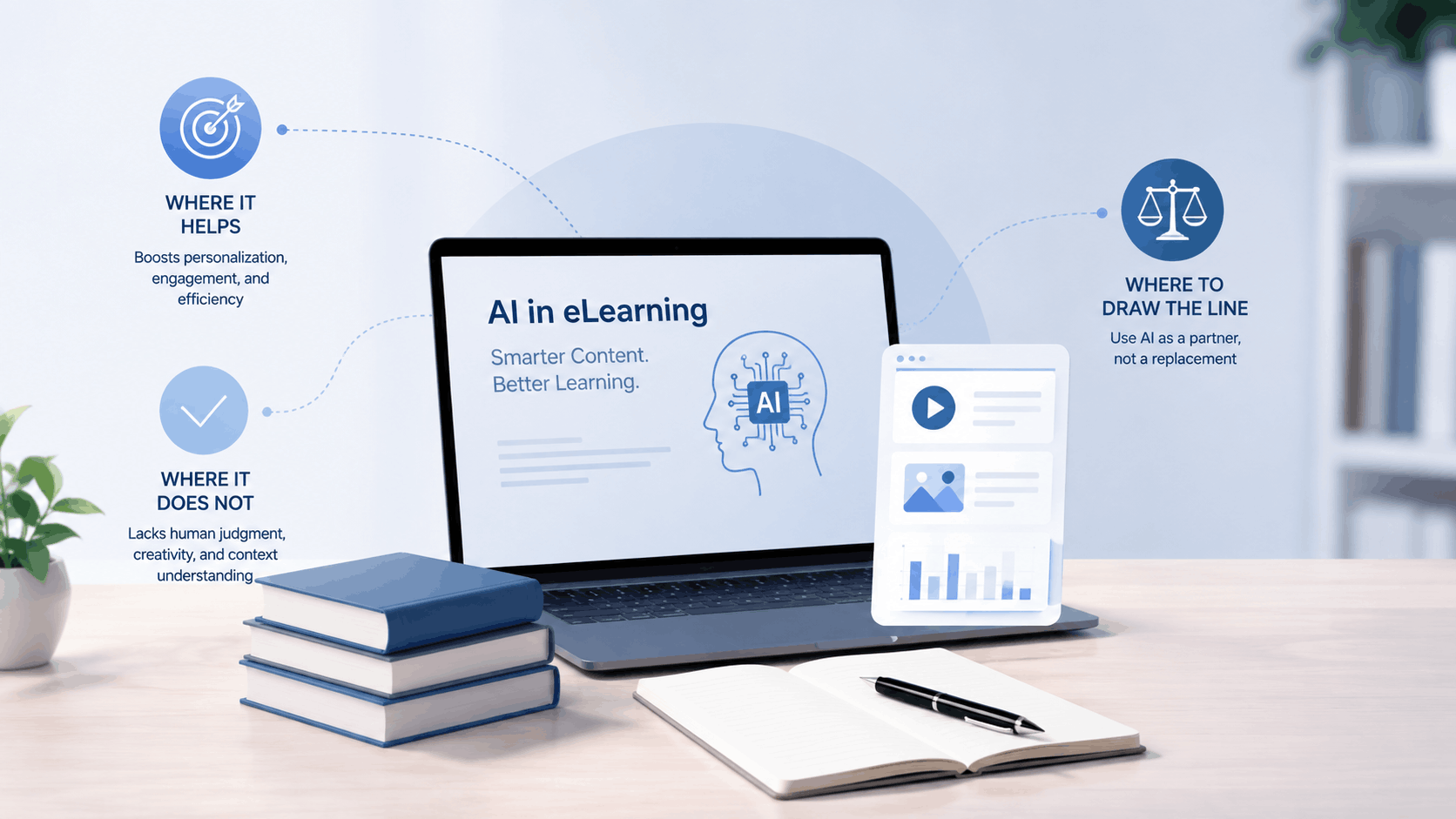
Where AI genuinely helps in eLearning content development, where it doesn't, and the risks of over-relying on it.
An Honest Starting Point
AI tools have genuinely changed parts of the eLearning content development workflow over the past few years, and the claims made about what AI can do for content production range from legitimately useful to considerably overstated. The most useful way to evaluate any specific AI claim is to ask a narrow question: does this replace judgement, or does it accelerate a task that still needs judgement applied afterward? The answer determines whether AI adds real value or introduces quality risk.
Where AI Genuinely Helps Today
- Adaptive assessment and item variation. AI can generate question variants and adjust difficulty pathways based on learner performance far faster than manual authoring, provided the underlying question bank has already been through genuine SME and quality review.
- Content structuring and first-draft organisation. Turning raw source material, transcripts, or SME interviews into a structured outline saves real instructional design time, functioning as a fast first pass rather than a finished product.
- Translation workflow acceleration. AI-assisted translation, combined with human review, speeds up the first-pass translation step significantly, especially for high-volume, lower-cultural-sensitivity content.
- Accessibility automation for specific tasks. Auto-generating draft alt text, flagging colour contrast issues, or checking heading structure gives accessibility reviewers a faster starting point, though final sign-off still needs human review against WCAG success criteria.
- Production efficiency tasks, such as generating first-draft voiceover scripts, initial storyboard text, or scene descriptions that a human editor then refines.
Where AI Does Not Reliably Help (Yet)
- Instructional design judgement. Deciding what a learner actually needs to be able to do differently, and designing the learning journey to get them there, remains a human expertise problem, not a pattern-matching one.
- Culturally nuanced transcreation. AI translation without human cultural review regularly misses the nuance that separates translation from genuine transcreation, particularly in scenario-based content.
- High-stakes accuracy verification. Technical, medical, legal, and compliance content still requires genuine SME fact-checking; AI-generated content in these domains without expert review carries real accuracy risk.
- Final accessibility sign-off. Automated accessibility tools catch a meaningful subset of issues but reliably miss others, particularly around cognitive accessibility and genuinely meaningful alt text, that require human judgement.
- Emotionally resonant scenario writing. AI-drafted soft-skills scenarios often read as generic or slightly off in tone until a skilled instructional designer reworks them for authenticity.
A Practical Framework for Evaluating AI Use in Your Content Pipeline
| Task Type | Appropriate AI Role | Required Human Oversight |
|---|---|---|
| First-draft content structuring | High — AI does the heavy lifting | Medium — human reorganises and refines |
| Assessment item variation | Medium-high, once base bank is SME-reviewed | High — new variants still need spot review |
| Translation | Medium — accelerates first pass | High — human cultural and linguistic review required |
| Accessibility checks | Medium — flags issues efficiently | High — final compliance sign-off stays human |
| Instructional design decisions | Low | Very high — this stays a human expertise function |
| High-stakes technical accuracy | Low | Very high — SME verification is non-negotiable |
The Risks of Over-Reliance
- Publishing AI-drafted content without SME verification in technical or regulated domains, where inaccuracies carry real consequences
- Treating AI-generated first drafts as finished content rather than a starting point, quietly eroding quality over many modules
- Assuming automated accessibility checks are sufficient for compliance sign-off, which creates legal exposure
- Losing the instructional design rigour that actually drives learning outcomes, because AI can generate content quickly enough to skip the design step entirely
The Bottom Line
The organisations getting real value from AI in eLearning content development are the ones using it to accelerate specific, well-bounded tasks while keeping human judgement firmly in place for instructional design, cultural nuance, technical accuracy, and accessibility sign-off. The organisations running into quality problems are the ones that let AI's speed advantage quietly erode the review steps that used to catch these issues.
Margo Learning uses AI deliberately across its own production pipeline, exactly where it adds genuine value, while keeping instructional design, SME verification, and accessibility sign-off firmly human.