
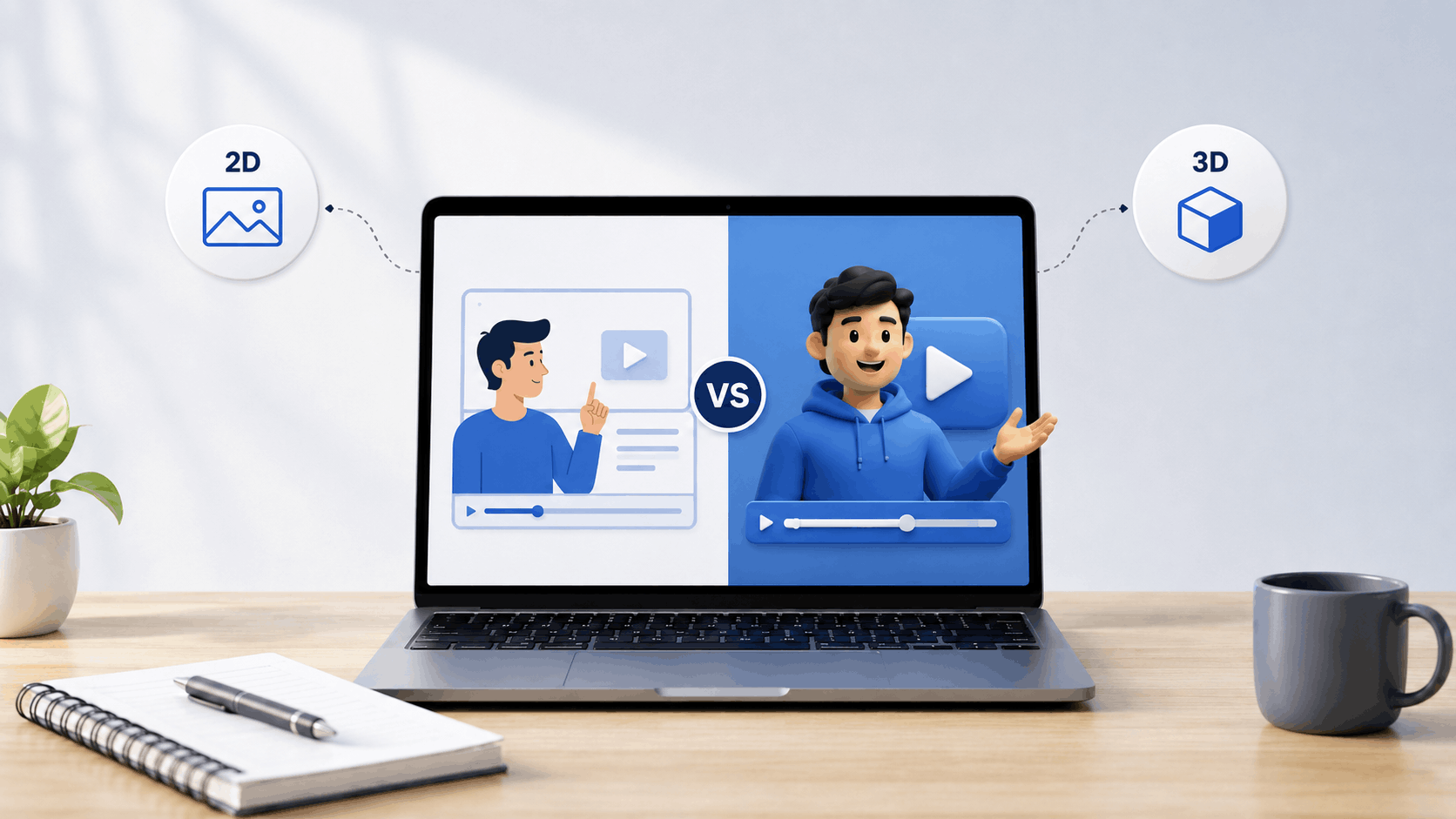
A practical framework for choosing 2D or 3D animation for eLearning, with examples across K-12, corporate, and STEM training.
Why This Decision Is Rarely About Budget Alone
2D and 3D animation are often framed as a simple cost trade-off: 2D is cheaper, 3D is more expensive, pick based on what you can afford. In practice, the right choice depends on what the content needs to demonstrate, who the learners are, where the content will be deployed, and what the learning objective actually requires — budget is one input among several, not the deciding factor.
Picking the wrong format doesn't just waste budget. It can genuinely undermine the learning outcome, either by under-representing a concept that needed spatial or mechanical detail, or by over-producing a concept that never needed it.
The Decision Framework
- Does the content need to show spatial relationships or internal mechanics? Anatomy, machinery, engineering processes, and chemical reactions usually need 3D to show how components relate and move in space.
- Is the content emotionally or narratively driven? Character-led storytelling, soft-skills scenarios, and empathy-building content often work better in 2D, which reads as warmer and more approachable to most audiences.
- What is the deployment platform and device mix? 3D assets carry heavier file sizes and rendering requirements — a concern for low-bandwidth regions or older devices common in some K-12 and public-sector deployments.
- What is the audience's age and context? Younger K-12 audiences often respond well to 2D character-driven content; adult technical and corporate audiences frequently expect 3D for procedural or equipment-based training.
- How long is the content's shelf life? 3D asset libraries are more reusable and adaptable across future modules once built; 2D assets are faster to produce but often more one-off per module.
2D vs 3D: A Practical Comparison
| Factor | 2D Animation | 3D Animation |
|---|---|---|
| Best for | Narrative, character-driven, soft skills, K-12 storytelling | Technical, mechanical, spatial, procedural training |
| Typical cost | Lower | Higher |
| Typical production time | Faster | Slower |
| File size / device demands | Lighter, broad device compatibility | Heavier, benefits from stronger devices/bandwidth |
| Reusability across future content | Lower — assets are often scene-specific | Higher — rigged models can be reused and repositioned |
| Emotional tone | Warmer, more approachable | More literal, more clinical |
Examples Across Content Contexts
- K-12: A 2D animated character guiding young learners through a foundational literacy module builds warmth and consistency across a series; 3D would add cost without adding learning value here.
- Corporate technical training: A 3D walkthrough of assembling or troubleshooting equipment lets learners see spatial relationships a 2D diagram cannot represent clearly.
- STEM content: Molecular structures, physics simulations, and engineering processes typically demand 3D to show mechanics accurately.
- Soft-skills and leadership training: 2D character scenarios (a difficult conversation, a feedback scenario) often land better emotionally than 3D avatars, which can feel uncannily close to real without matching real nuance.
Common Mistakes
- Defaulting to 3D because it looks more "premium," even when the content is narrative or emotional rather than spatial or mechanical
- Choosing 2D purely for cost savings on content that genuinely needs to demonstrate spatial or mechanical detail
- Not accounting for the device and bandwidth constraints of the actual deployment environment before committing to 3D
- Treating the decision as fixed for an entire curriculum rather than making it per-module based on what each specific piece of content needs
The Bottom Line
The right animation format follows the content, not the budget line item. A framework built around spatial complexity, emotional tone, deployment constraints, and audience context consistently produces better decisions than defaulting to whichever format is cheaper or more visually impressive on a sales reel.
Margo Learning applies exactly this decision framework with clients across K-12, corporate, STEM, and technical training contexts, recommending 2D or 3D based on what the content actually needs to teach.